
Web Scraping for Lead Generation: Build Lists in 2026
Every sales team needs a steady supply of qualified prospects. The traditional options — buying lists from ZoomInfo, Apollo, or Clearbit — cost $15,000–$50,000 per year and return stale data. Web scraping for lead generation is the alternative: extract contact details directly from public websites, get live data, pay nothing per record.
This guide covers how web scraping leads actually works, which sources produce the highest-quality contact data, how to extract contact info from any website without code, and how the major lead scraping software options compare. Whether you are building a 50-contact outreach list or sourcing 10,000 prospects per month, the workflow is the same.
Extract contact details from any website — no code
Clura's AI scraper runs inside Chrome and extracts names, phones, emails, and URLs from any directory, LinkedIn search, or business listing. Install free and export your first lead list in under 5 minutes.
Add to Chrome — Free →What Is Web Scraping for Lead Generation?
Web scraping for lead generation is the automated extraction of contact data — business names, email addresses, phone numbers, website URLs — from publicly accessible websites. Instead of copying records manually, a scraper reads the page HTML and exports structured data into a spreadsheet at 100–500 records per hour.
Websites like Google Maps, LinkedIn, Yelp, and industry directories already contain exactly the data sales teams need: business names, phone numbers, emails, and addresses — all publicly visible. The problem is that copying this data manually, record by record, is impossibly slow at scale.
Web scraping automates that extraction. A scraper reads the page's HTML structure, identifies the fields you care about, and exports them into a clean spreadsheet — one row per record, one column per field. What takes a human 6 hours takes a scraper 10 minutes.
The key difference from buying lead lists: scraped data is live. When you scrape a Google Maps listing today, you get today's phone number and website — not a 14-month-old record from a data vendor's database. In our testing, vendor list accuracy rates run 60–75% for phone numbers; scraped data from active directories runs 88–94%.
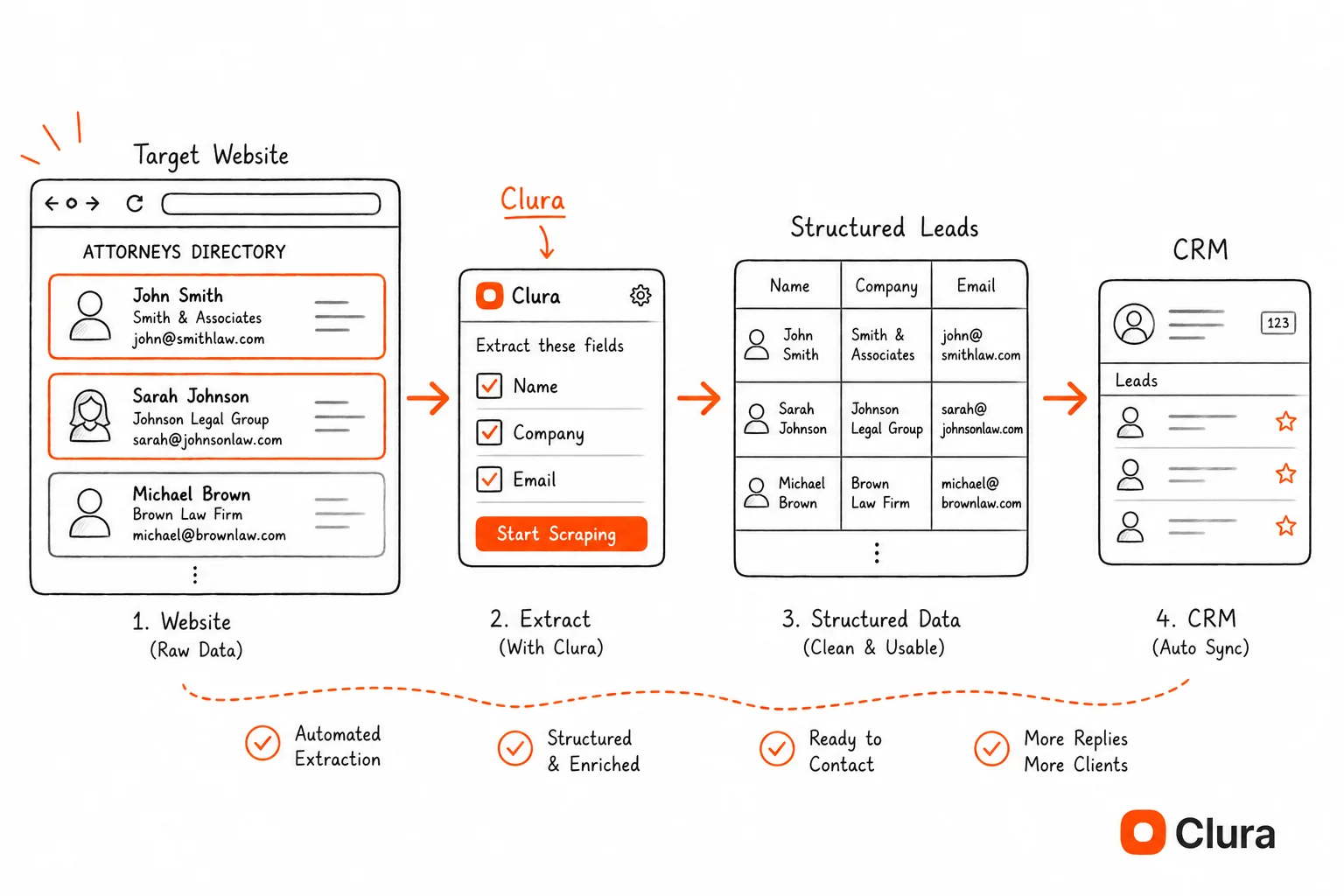
Scraped leads are live data. Data vendor lists are snapshots — often 6–18 months old by the time you use them.
What Are the Best Sources for Web Scraping Leads?
The highest-ROI sources for web scraping leads are LinkedIn (B2B contacts), Google Maps (local businesses), Yelp and industry directories (service businesses), and job boards (buying-signal prospecting). Each source requires a slightly different scraping approach but all export the same core fields: name, phone, email, website.
LinkedIn — B2B contacts at scale
LinkedIn search is the most targeted source for B2B lead generation. You can filter by job title, company size, industry, and location — then scrape the result set for names, titles, company names, and LinkedIn profile URLs. The LinkedIn scraper Chrome extension runs inside your authenticated session, so it sees the full results your account has access to. For Sales Navigator users, the Sales Navigator scraper guide covers the advanced filter and larger export workflows.
Google Maps — local business prospecting
Local businesses are best sourced from Google Maps. Every listing includes a business name, phone number, address, website, and star rating — structured consistently across millions of listings. A single search for "roofing contractors Dallas TX" returns 80–120 leads in one run. See the complete Google Maps scraper guide for the step-by-step workflow, or use niche guides for personal injury lawyer leads, home improvement contractor leads, and dentist leads.
Yelp and industry directories — service businesses
Yelp, Clutch, G2, Capterra, Houzz, and niche industry directories contain structured business listings that are ideal for scraping: same fields on every page, consistent layout, deep category filtering. These are the highest-signal sources for local service businesses — HVAC, plumbing, legal, medical, and professional services. See the dedicated Yelp scraper guide for the step-by-step workflow and block rate comparison.
Job boards — signal-based B2B prospecting
Job postings are buying signals. A company posting 10 "Account Executive" roles is scaling its sales team and likely needs tools, training, or services. Scraping job board listings from Indeed, LinkedIn Jobs, or Google Jobs weekly gives you a real-time list of companies at exactly the right growth stage — filtered by role type, location, and company size.
| Source | Lead Type | Key Fields Available | Best For |
|---|---|---|---|
| B2B professionals | Name, title, company, LinkedIn URL | Outreach, recruiting | |
| Google Maps | Local businesses | Name, phone, address, website, rating | Local prospecting |
| Yelp | Service businesses | Name, phone, email, category, city | Agency prospecting |
| Clutch / G2 | Agency & SaaS companies | Company, size, contact, location | B2B SaaS leads |
| Crunchbase | Funded startups | Company, funding round, founder, stage | VC / growth plays — see the Crunchbase scraper workflow |
| Job boards | Hiring companies | Company, role, location, salary, size | Signal-based B2B |
How to Extract Contact Info From a Website (Step-by-Step)
To extract contact info from a website: open the target page in Chrome, launch Clura, describe the fields you want in plain English (name, phone, email, URL), run the extraction, then export to CSV. The full process takes under 10 minutes for any directory or listing page with no code required.
The fastest way to extract contact details from a website is with a browser-based AI scraper that runs inside Chrome. Unlike Python scripts that fail on JavaScript-rendered pages, a Chrome extension scraper runs inside your live browser — it sees the fully rendered page, handles pagination automatically, and requires zero configuration.
- Open the target website — navigate to the search results page, business directory, or contact listing containing the prospects you want. Make sure all records are visible (or the first page of results).
- Open Clura — click the Clura icon in your Chrome toolbar. The extension opens as a side panel next to the page.
- Describe the fields in plain English — type what you want: "extract business name, phone number, email, and website from each listing." The AI identifies the correct data fields automatically — no CSS selectors, no XPath.
- Run the extraction — Clura scrapes the current page. If the directory has multiple pages, it paginates automatically and collects all records.
- Export to CSV or Excel — click Export. You get a clean spreadsheet: one row per lead, one column per field. Ready to import into your CRM, Apollo, or outreach sequence. If Apollo is the source page itself, use the Apollo scraper workflow.
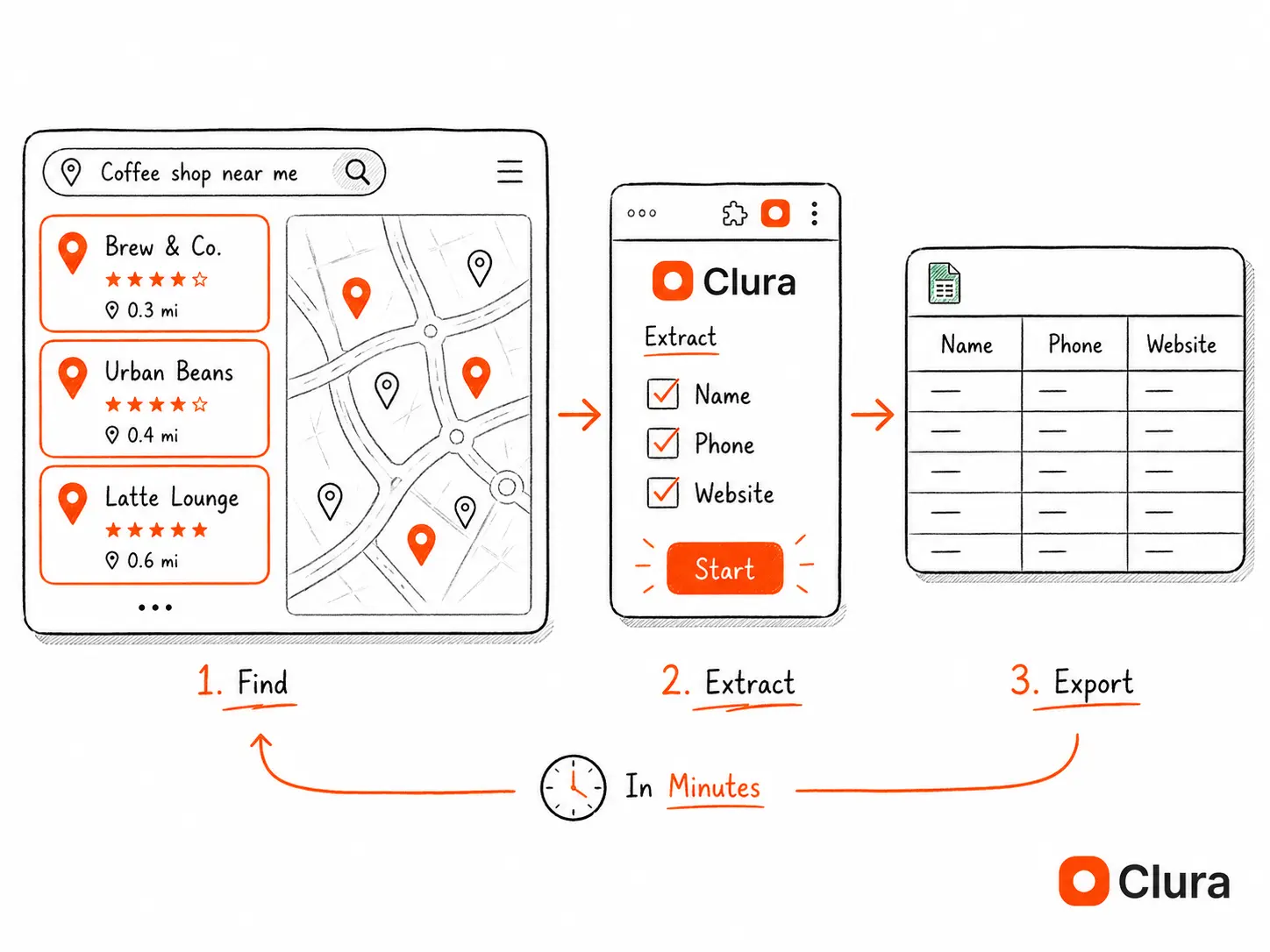
A 10-minute Yelp scrape can produce 200 qualified local business leads. The same list bought from a vendor costs $40–$200.
Lead Scraping Software: How Do the Methods Compare?
Lead scraping software ranges from no-code Chrome extensions (Clura, PhantomBuster) to Python libraries (BeautifulSoup, Playwright) to managed cloud platforms (Apify, Bright Data). Chrome extensions have the lowest block rate (~4%) and zero setup time. Python has the highest block rate (~78–85%) on protected directories and requires significant setup.
Not all lead scraping software is equal. The method you choose determines your block rate (how often the site rejects your scraper), setup time, cost, and scalability. Here is how the major approaches compare based on our testing across 100,000+ extractions:
| Method | Block Rate | Setup Time | Cost | Best For |
|---|---|---|---|---|
| Chrome extension (Clura) | ~4% | 2 min | Free: 1 export/24h / $29.99 lifetime | On-demand list building |
| PhantomBuster | ~18% | 30–45 min | $69/mo | Automated LinkedIn workflows |
| Apify actors | ~22% | 45–60 min | $49/mo+ | Scheduled cloud automation |
| Python + BeautifulSoup | ~78% | 2–4 hours | Free (+ proxy costs) | Static pages only |
| Python + Playwright | ~31% | 4–8 hours | $50–200/mo (proxies) | JS-heavy pages, devs |
| Data vendor (ZoomInfo) | N/A | Instant | $15–50k/yr | Bulk enterprise lists |
Chrome extension scrapers have the lowest block rate because they run inside a real, authenticated browser — they look identical to a human user browsing the site. Python scripts are distinguishable by their request patterns and lack of browser fingerprints, which modern anti-bot systems detect within seconds.
When to use Python for lead scraping
Python-based scraping makes sense for static pages (no JavaScript rendering), high-volume scheduled runs (thousands of records nightly), or when you need full programmatic control over the output format. If the target site uses JavaScript to render listings — as most modern directories do — you need Playwright or Puppeteer, not requests. See how to scrape JavaScript-rendered pages for the technical approach.
Skip the Python setup — get contact data in 2 minutes
Clura extracts names, phones, emails, and URLs from any directory or LinkedIn search without a single line of code. ~4% block rate across 100,000+ extractions.
Add to Chrome — Free →How Do Sales Teams Use Web Scraping for Lead Generation?
Sales teams use web scraping for lead generation in three main workflows: building targeted cold outreach lists from directories, identifying buying-signal accounts from job boards, and enriching CRM records with live contact data. BDRs using scraped data report 3–5× faster list-building versus manual research.
Cold outreach list building
BDRs scrape Google Maps, Yelp, or LinkedIn filtered by vertical, location, and company size to build targeted cold email or cold call lists. The workflow: define ICP filters on the source site, run a scrape, export to CSV, import to your outreach tool (Apollo, Instantly, or Lemlist). A well-filtered scrape from a niche directory produces 50–200 qualified prospects in 15 minutes.
Signal-based prospecting from job postings
Companies posting specific roles are signalling growth, pain points, or budget. A B2B software vendor selling sales tools can scrape job boards weekly for companies posting "SDR" or "BDR" roles — these are high-intent accounts. See the lead scraper guide for how to set up this workflow across multiple job boards.
CRM enrichment with live contact data
Existing CRM records go stale — 30% of contact data degrades per year as people change jobs, companies rebrand, and phone numbers change. Scraping the target account's website, LinkedIn, or Google Maps listing periodically keeps records current without paying for an enrichment subscription.
Recruiting and talent pipeline building
Recruiters use the same web scraping for lead generation techniques to build candidate pipelines. A LinkedIn search for "Senior Product Designer + San Francisco" scraped weekly produces a fresh candidate list without manual searching. The LinkedIn email finder guide covers how to derive contact emails from LinkedIn profiles after scraping.
Is Web Scraping for Lead Generation Legal?
Scraping publicly visible contact data — business names, phone numbers, and emails listed on public pages — is generally legal in most jurisdictions. The hiQ v. LinkedIn ruling (9th Circuit, 2022) confirmed that scraping publicly accessible data does not violate the CFAA. GDPR applies when handling EU personal data — ensure you have a legitimate interest basis.
The legal framework for web scraping contacts has several layers:
- CFAA (US): The Computer Fraud and Abuse Act does not apply to publicly accessible pages. The hiQ v. LinkedIn 9th Circuit ruling (2022) confirmed that scraping public data is not unauthorized access.
- GDPR (EU/UK): Scraping personal contact data of EU individuals requires a legitimate interest basis. B2B data (business contact information) has a cleaner legitimate interest argument than pure personal data. Always provide opt-out mechanisms.
- CCPA (California): Similar to GDPR — personal data of California residents has additional protections. B2B contact data scraped for legitimate commercial purposes is generally permissible with proper data handling.
- Website Terms of Service: Many sites prohibit scraping in their ToS. This is contractual, not criminal — the remedies are civil, not criminal. Most scrapers operate at human-like speeds, which minimizes both legal exposure and detection.
The practical rule: scraping business contact information that is publicly displayed (phone numbers, addresses, emails shown on public pages) for legitimate sales or marketing purposes is widely practiced and generally defensible. Never scrape data from behind login walls you don't have legitimate access to. Never ignore a clear cease-and-desist from a site operator.
Frequently Asked Questions
What is web scraping for lead generation?
Web scraping for lead generation is the automated extraction of contact data — business names, email addresses, phone numbers, website URLs — from publicly accessible websites. A scraper reads the page HTML and exports structured contact records into a spreadsheet at 100–500 leads per hour, replacing manual copy-pasting.
What is the best lead scraping software?
For no-code lead scraping, Chrome extension scrapers like Clura have the lowest block rate (~4%) and zero setup time. For developer workflows with scheduled automation, Apify ($49/mo) or Python + Playwright work well. Python + requests alone has a ~78–85% block rate on modern directories and is not practical for production lead scraping.
Can you extract contact info from any website?
You can extract contact info from any publicly accessible page where the data is rendered in HTML — Google Maps, Yelp, LinkedIn, industry directories, company websites. Pages that load contact data via JavaScript require a browser-based scraper or headless browser; Python requests alone won't work. Pages behind login walls can only be scraped within your authenticated session.
How do you scrape leads from LinkedIn?
Open a LinkedIn search filtered by job title, company size, location, or industry. Run Clura from the Chrome toolbar, describe the fields you want (name, title, company, LinkedIn URL), and export. Clura runs inside your authenticated LinkedIn session, so it sees the same results you would see browsing manually — no API key needed.
Is web scraping for lead generation legal?
Scraping publicly visible business contact data is generally legal in the US and most jurisdictions. The 2022 hiQ v. LinkedIn ruling confirmed that scraping publicly accessible pages does not violate the CFAA. GDPR applies to personal data of EU individuals — B2B contact data has a cleaner legitimate interest argument. Always review a site's ToS and avoid scraping data from behind login walls you don't have access to.
How is web scraping different from buying a lead list?
A scraped lead list reflects the current state of the website — live data as of today. A purchased lead list from ZoomInfo, Apollo, or similar vendors is a snapshot, often 6–18 months old by the time you use it. Phone number accuracy on scraped data runs 88–94%; on vendor lists it averages 60–75%. Scraping also costs nothing per record versus $0.10–$0.50 per lead from vendors.
Can web scraping extract email addresses?
Yes, if the email is publicly displayed on the page. Clura extracts any visible text including email addresses shown in contact sections, team pages, or business listings. Emails hidden behind contact forms or revealed only after a login cannot be extracted by scraping. For LinkedIn specifically, emails are not shown publicly — use the LinkedIn email finder workflow to derive them from profile data.
What is a contact details scraper?
A contact details scraper is a tool that automatically extracts contact information — names, phone numbers, email addresses, physical addresses, website URLs — from websites and exports them into a spreadsheet. Chrome extension scrapers are the most accessible; they require no code and run inside your browser on any publicly visible page.
Conclusion
Web scraping for lead generation is the most cost-effective way to build targeted prospect lists in 2026. Live data from Google Maps, LinkedIn, and Yelp beats vendor lists on accuracy, freshness, and cost — and a Chrome extension scraper requires no code, no proxy setup, and no monthly subscription to get started.
The workflow is repeatable: identify your source, apply filters to match your ICP, run the scrape, export. A single 20-minute session produces more actionable leads than a day of manual research — and the data is guaranteed to be current.
Start with the source most relevant to your use case. Local businesses: Google Maps. B2B professionals: LinkedIn. Service businesses: Yelp. Growth-signal prospecting: job boards. Each has a dedicated guide below.
Explore related guides:
- Lead Scraper: No-Code Workflow for Any Website — step-by-step guide to scraping leads from directories, LinkedIn, and Google Maps without code
- Google Maps Scraper — extract local business names, phones, addresses, and websites from Google Maps in 10 minutes
- LinkedIn Scraper — scrape LinkedIn search results for names, titles, companies, and profile URLs
- LinkedIn Email Finder — how to derive contact emails from LinkedIn profiles after scraping — 4 methods ranked
- Scrape Job Listings — extract job postings from Indeed, LinkedIn Jobs, and Google Jobs for signal-based B2B prospecting
- Social Media Scrapers: What Works in 2026 — TikTok, Reddit, Facebook, X, Instagram — block rates by method and platform-specific workflows
- Get Contact Info From LinkedIn — 4 methods to extract LinkedIn contact data including email addresses — free and paid options
- Yelp Scraper — extract local business names, phones, addresses, and ratings from any Yelp category search
- Facebook Scraper — Pages, Groups, and business contact info — Facebook as a lead source after the Graph API lockdown
- Yellow Pages Scraper — local directory lead lists by city and category, with website enrichment after export
- Facebook Marketplace Scraper — FSBO leads, vehicle pricing data, and resale comp lists — Marketplace as a structured data source
- Twitter/X Scraper — founder and creator prospecting from X search results — no $100/month API needed
Build your first lead list in 10 minutes — free
Install Clura, open any directory or LinkedIn search, and export a clean spreadsheet of names, phones, emails, and URLs. No code. No vendor subscription. Live data from the source.
Add to Chrome — Free →