
What Is Lead Scoring? A Practical Guide to Smarter Sales
Clura Team
Lead scoring is a powerful method for ranking prospects on a scale from hot to cold, based on who they are and how they interact with your brand. Not all leads are created equal — some are ready to buy right now, while others are just browsing. Lead scoring is the automated system that flags your most promising opportunities so your team can focus energy where it matters most.
This guide breaks down exactly what lead scoring is, why 75% of B2B organisations now use it, and how you can build your first model today — from defining your Ideal Customer Profile to setting MQL and SQL thresholds that align marketing and sales.
Enrich Your Lead Scoring Model with Fresh Data
Clura automatically pulls job titles, company sizes, and tech stacks from any website — so your lead scores are always based on accurate, up-to-date information.
Add to Chrome — Free →What Is Lead Scoring? A Simple Introduction
Lead scoring assigns numerical values to prospects based on their profile fit and behavioural signals, creating a single score that tells your sales team who to call first — eliminating guesswork from pipeline prioritisation.

Lead scoring turns sales from a guessing game into a data-driven science. It ensures that when a lead gets to your sales team, they aren't just any lead — they are the right lead.
| Component | What It Means | Example |
|---|---|---|
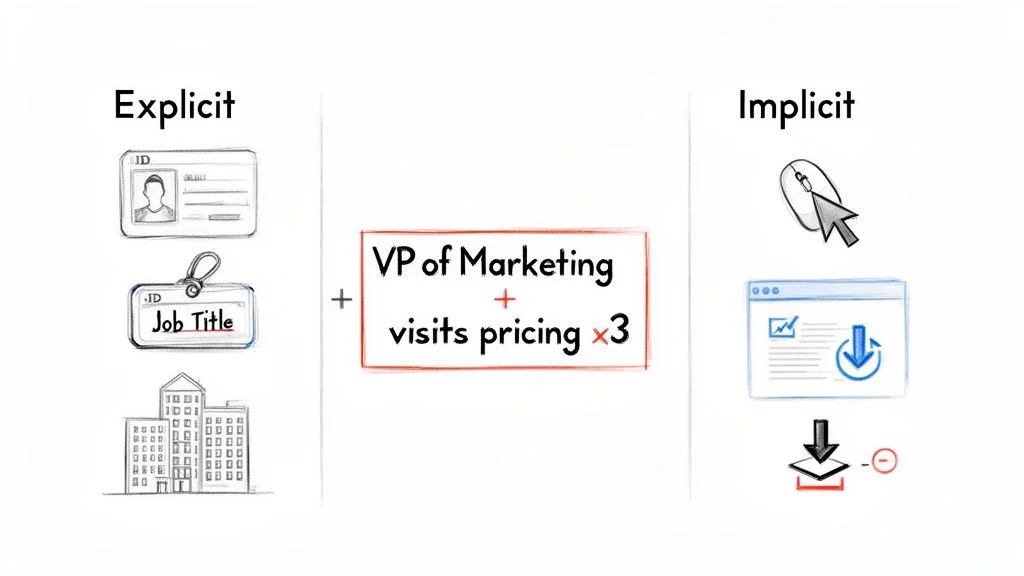
| Demographics/Firmographics | Who the lead is — company, role, location | VP of Marketing at a 500-person tech company |
| Behavioural Data | What the lead does — website visits, email opens, downloads | Visited the pricing page 3 times in one week |
| Point System | Values assigned to attributes and actions | +10 for Director title; +15 for demo request |
| Score Threshold | The 'magic number' that defines a Sales-Qualified Lead | Any lead with 100+ points is sent to sales |
Lead scoring also solves the age-old marketing vs. sales blame cycle. It creates a single, data-driven definition of what a 'good lead' looks like — marketing focuses on generating leads that hit the agreed threshold, sales prioritises every lead that meets the score. The result: a unified revenue team and a predictable pipeline.
Why Modern Sales Teams Need Lead Scoring
Companies using lead scoring see 177% higher lead generation ROI than those that don't — because it replaces guesswork with a system that directs sales energy toward the prospects most likely to close.
Without a scoring system, a sales rep's day is pure guesswork. They might spend hours chasing someone who just wanted a free ebook, while a CEO who watched your demo video slips through the cracks.
Lead scoring gives your sales team a superpower: the ability to see who's hot and who's not. Reps log in each morning to a perfectly prioritised list — they know exactly who to call first, second, and third.
- 75% of B2B organisations now use lead scoring — up from just 23% in 2015 (Gartner).
- Companies using lead scoring see 177% higher lead generation ROI than those who don't.
- Sales reps connect with the right people faster, have more meaningful conversations, and close more deals.
The Anatomy of a Killer Lead Scoring Model
A complete lead scoring model combines explicit data (who the lead is: title, company size, industry) with implicit data (what they do: page visits, downloads, demo requests) plus negative scoring that automatically filters out poor-fit leads.
Explicit Data: Are They the Right Fit?
Explicit data is what a lead tells you in forms: job title, company size, industry, and location. It's your first-pass filter — does this person match your Ideal Customer Profile? You don't have to rely on forms alone; see our guide on what is data enrichment for how AI scraping tools fill these gaps automatically.
Implicit Data: Are They Showing Real Interest?
- Website activity: homepage browse vs. 10 minutes on your pricing page.
- Content engagement: opening every email and downloading technical whitepapers.
- Frequency of visits: first visit or returning three times this week.
- Time on page: five-second bounce vs. reading your entire case study.
Don't Forget Negative Scoring
Negative scoring is your model's immune system. It proactively identifies and flags leads that will never convert, keeping your pipeline healthy and your sales reps focused.
- Unqualified job titles (Student, Intern): subtract points automatically.
- Competitor domains: disqualify from sales follow-up.
- Personal email addresses (@gmail.com, @yahoo.com): flag as lower-priority.
- 90+ days of inactivity: decay the score to reflect cold interest.
How to Build Your First Lead Scoring Model from Scratch
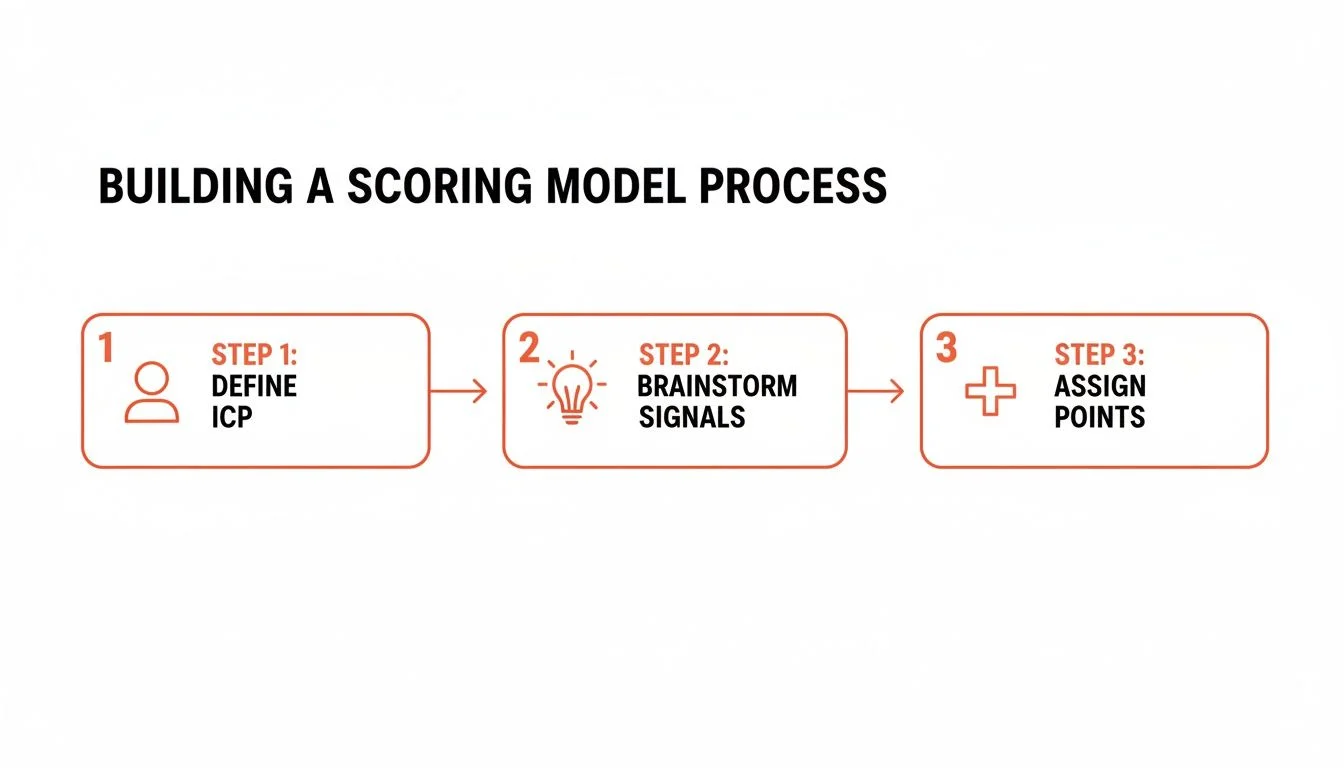
Build a lead scoring model in three steps: define your Ideal Customer Profile, brainstorm explicit and implicit signals, then assign point values and test with a sample scoring matrix.
Step 1: Define Your Ideal Customer Profile
Gather sales and marketing and answer: What company size is the sweet spot? Which industries succeed most with your solution? What geography and tech stack matter? Your ICP is the bullseye you're aiming for.
Step 2: Brainstorm Your Key Data Signals
List both explicit signals (title, company size, industry) and implicit signals (demo request, pricing page visit, webinar attendance). Include your red flags for negative scoring: student emails, competitor domains, long inactivity.
Step 3: Assign Point Values
| Category | Attribute or Behaviour | Points |
|---|---|---|
| Explicit (Fit) | Job Title: C-Level/VP | +15 |
| Explicit (Fit) | Job Title: Director | +10 |
| Explicit (Fit) | Company Size: 101–500 Employees (ICP Match) | +10 |
| Implicit (Intent) | Requested a Demo | +25 |
| Implicit (Intent) | Visited Pricing Page | +15 |
| Implicit (Intent) | Attended a Webinar | +10 |
| Negative | Job Title: Intern/Student | −10 |
| Negative | Email Domain: Gmail/Yahoo | −5 |
| Negative | No engagement in 90+ days | −15 |
Keep Your Lead Data Fresh and Accurate
Clura automatically enriches your lead records with up-to-date job titles, company sizes, and tech stack data from any website — so your scoring model always fires on accurate information.
Add to Chrome — Free →The Future of Scoring: Predictive AI Models
Predictive lead scoring uses machine learning trained on your historical CRM data to automatically discover which signals truly correlate with closed deals — achieving up to 85% conversion prediction accuracy.
A rules-based model is like a hand-drawn map. A predictive AI model is like a live GPS, automatically rerouting you in real-time. Instead of you deciding that a Director title is worth +10 points, the AI analyses every won and lost deal in your CRM and discovers the true weights for hundreds of signals simultaneously.
- Self-optimising: continuously learns from new data — no manual tweaks required.
- Deeper insights: spots complex relationships between dozens of signals a human analyst would miss.
- Blazing speed: scores thousands of leads in real-time as new information flows in.
- Unbiased: pure data analysis, stripping away gut feelings that creep into manual scoring.
Today's AI models forecast conversion probabilities with up to 85% accuracy and have been shown to slash lead nurturing costs by 33%. See the ultimate guide to lead scoring trends for more data.
Putting Your Lead Scoring System into Action
Implement lead scoring by setting MQL and SQL score thresholds agreed on by both marketing and sales, then reviewing and refining the model quarterly based on closed deal data.
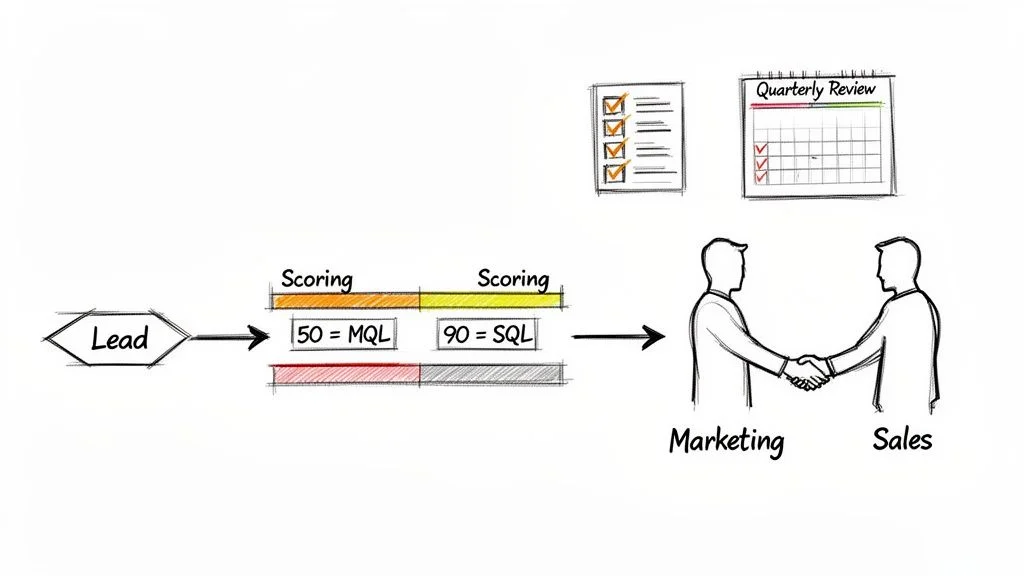
Set two key thresholds: MQL at ~50 points (marketing sees potential, not yet ready for a hard sell) and SQL at ~90 points (strong buying intent, hand off to sales immediately). These numbers must come from an honest conversation between marketing and sales leadership.
Your lead scoring model is a living system, not a 'set it and forget it' project. Markets shift and buyers change. Your model has to evolve with them.
Review quarterly: analyse closed deals to see what scores converted, get sales feedback on whether high-scoring leads are truly the best, and refine point values accordingly. For more on qualification, see our guide on how to qualify sales leads.
Frequently Asked Questions
How often should I update my lead scoring model?
Plan for a full review at least once per quarter. Your model is a living system — be ready to make quick adjustments whenever you launch a major campaign, roll out a new product, or see a sudden shift in lead quality. Markets change faster than annual reviews can track.
What's the difference between MQL and SQL?
An MQL (Marketing Qualified Lead) fits your ideal profile and has shown some interest — like downloading an ebook. An SQL (Sales Qualified Lead) has taken a direct action signalling strong buying intent, like requesting a demo. Your lead score is the number that automatically separates the two, typically MQL at ~50 points and SQL at ~90.
Can a lead's score go down?
Absolutely — it should. Negative scoring subtracts points for poor-fit signals (generic email addresses, unqualified job titles) and fading interest (no engagement in 90+ days). This keeps your pipeline clean and your sales team focused on opportunities most likely to close.
What data sources can I use to enrich lead scores?
Beyond form fills, you can use web scraping tools to pull job titles and company sizes from professional networks, technographic data from tools like BuiltWith, and buying signals like recent job postings or funding announcements from Crunchbase. AI tools like Clura automate this enrichment from any website.
Conclusion
Lead scoring transforms your sales pipeline from a reactive queue into a prioritised, data-driven engine. By combining explicit profile data with behavioural signals — and subtracting points for poor-fit indicators — you give your sales team a superpower: knowing exactly who to call first.
Start with a simple spreadsheet-based model, align on MQL and SQL thresholds with your sales team, and review quarterly. As your data grows, layer in predictive AI to uncover the hidden patterns that separate your best customers from the rest.
Explore related guides:
- What Is a Business Lead — understand the different lead types before building your scoring model
- What Is Data Enrichment — automatically fill gaps in lead records using AI scraping tools
- How to Qualify Sales Leads — the frameworks top sales teams use to separate gold from gravel
Fuel Your Lead Scoring Model with Accurate, Fresh Data
Clura is a browser-based AI agent that helps you scrape and organise pristine lead data from any website with a single click. Explore our free plan today.
Add to Chrome — Free →About the Author