
eBay Price Tracker: Find Deals, Flip Products, and Beat Competitors
An eBay price tracker is an automated system that monitors listing prices across eBay and alerts you when prices move — so you never miss a deal as a buyer or lose sales as a seller.
eBay prices change constantly. Popular items can swing 20–30% in a single month. Without automation, you're always reacting to stale information. With a price tracker, you see every move in real time — and act before competitors even notice.
This guide shows you how to build an eBay price tracker without writing code, how to use it to find profitable flipping opportunities, and how to turn price data into a systematic competitive advantage. For the broader eBay data extraction guide, see eBay web scraping: the complete guide.
Track eBay Prices Automatically — No Code
Clura monitors any eBay search or listing and exports price data as a clean, structured CSV. Set it on a schedule and let fresh data come to you.
Add to Chrome — Free →Why You Need an eBay Price Tracker
Manual eBay price checking is slow, inconsistent, and always out of date. An automated price tracker monitors listings continuously, alerts you to significant price moves, and gives you the data to price smarter — whether you're buying for deals or selling for profit.
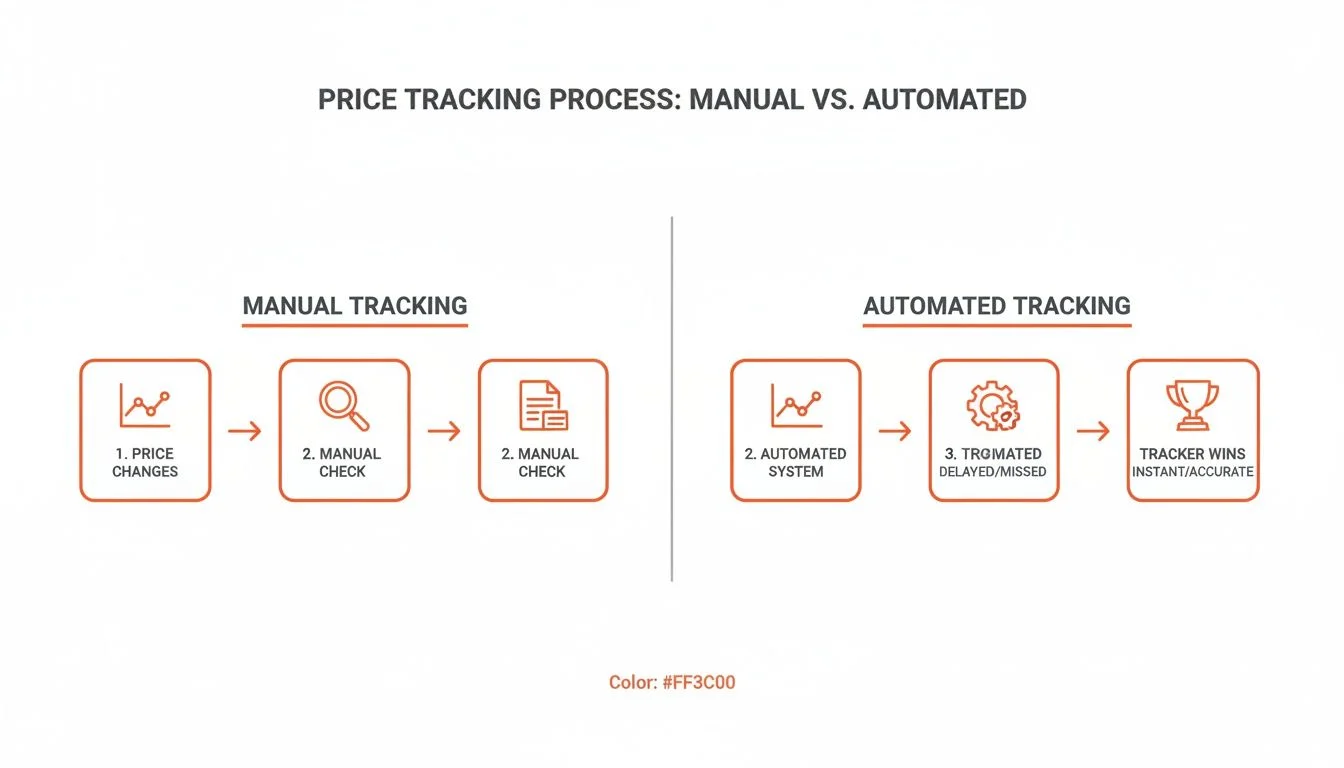
Prices for popular items on eBay can jump or fall 20–30% in a single month. A competitor could drop their price by 15% to clear stock and you might not notice for days — by which time you've already lost sales to the better-priced listing.
| Benefit | Impact | Example |
|---|---|---|
| Competitive Edge | React to competitor price changes in minutes, not days | Spot a rival's flash sale within hours of it going live |
| Time Savings | Eliminate manual checking entirely | Reclaim 5–10 hours/week previously spent on price checks |
| Profit Maximization | Price based on real-time market data | Increase average selling price 5–15% without hurting velocity |
| Deal Alerts | Get notified the instant a price hits your target | Buy below the 30-day average consistently |
An automated eBay price tracker doesn't just save you time — it flips your strategy. You stop chasing the market and start anticipating its moves.
Using Price Data to Find Flipping and Arbitrage Opportunities
eBay price tracking unlocks profitable flipping and arbitrage opportunities by revealing the gap between what sellers list and what buyers actually pay. Tracking sold listings data shows true market value — the foundation of any profitable reselling strategy.
Price tracking isn't just for staying competitive as a seller. For resellers and flippers, it's the core of a profitable sourcing strategy. The key insight: live listings show asking prices; sold listings show what buyers actually paid.
The Flipping Formula
- Track sold listing prices — find the real market value of items (not just what sellers hope to get)
- Identify price gaps — find categories where items are consistently selling above their listed price, signaling strong demand
- Monitor seasonal peaks — a vintage band tee selling for $28–$32 in winter might peak at $45 during summer festival season
- Watch for arbitrage windows — when a competitor sells out, prices rise; be positioned to capture that demand with inventory already in hand
Real Profit Examples
PS5 listings tracked over 30 days showed an average sold price of $499. When availability dropped, prices jumped to $549 — a $50-per-unit opportunity for sellers who tracked inventory levels alongside prices. In sneakers, limited colorways in size 11 can command a 50%+ premium over common sizes — but only if you track at the variation level, not just the product level.
One seller who automated sold listings analysis saw a 40% increase in successful sales, 25% higher average sale prices, and a 60% reduction in research time — by making data-driven sourcing decisions instead of gut-feel ones.
How to Build Your eBay Price Tracker (No Code)
Building an eBay price tracker with a no-code browser tool takes under five minutes: navigate to your target search, select the data fields you want to monitor (price, shipping, seller rating, sales volume), and run the extraction. Add a schedule to automate it going forward.
You don't need to write code or manage APIs. Here's the complete workflow using Clura:
- Define your target: Are you tracking a specific product category, a competitor's storefront, or individual listings? The more specific your search, the more actionable the data.
- Choose your data fields: At minimum, capture price, shipping cost, seller name, and the number of units sold. Add seller feedback score and item condition for deeper analysis.
- Launch the extraction: Navigate to the eBay page, open Clura, and click on each data field you want. The tool learns the pattern and applies it to every listing.
- Handle listing types: For Buy It Now listings, track the fixed price and sales velocity. For auctions, track current bid, number of bidders, and time remaining.
- Export and analyze: Download as CSV, open in Google Sheets or Excel, and calculate average, minimum, and maximum prices immediately.
Track What Actually Matters
- Price: Distinguish between Buy It Now prices and current auction bids — they represent different market signals
- Shipping costs: A low item price means nothing if shipping is outrageous. Always track total cost to buyer
- Seller reputation: A 99.8% feedback seller can often charge a 5–10% premium over an 85% seller for the same item
- Sales volume: The "sold" number on BIN listings is direct proof of demand — this is your most important signal
How to Automate Your eBay Price Monitoring
Set your price tracking workflow on a schedule that matches how fast your market moves: daily for high-velocity items like electronics and sneakers, weekly for stable categories, and monthly for long-term trend tracking on collectibles.
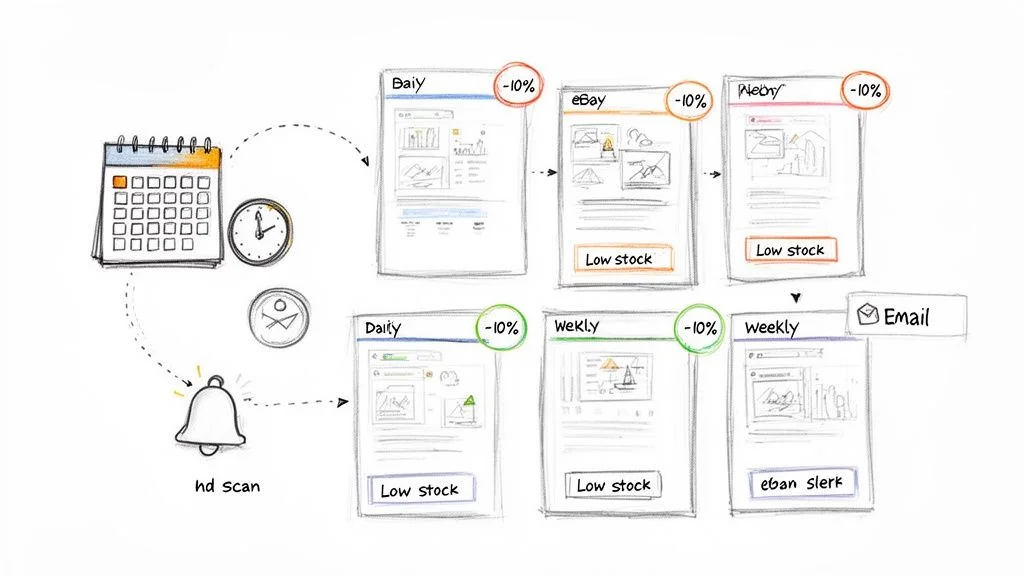
Matching Frequency to Market Speed
| Frequency | Best For | Example Categories |
|---|---|---|
| Daily | Fast-moving, high-demand products | New electronics, hyped sneakers, trending collectibles |
| Weekly | Standard product categories | Used books, auto parts, kitchen gadgets, clothing basics |
| Monthly | Long-term trend and value tracking | Vintage furniture, rare collectibles, high-ticket antiques |
Setting Smart Alerts
Don't just track — set specific triggers that prompt action. The most useful alerts:
- Key competitor price drops more than 10% → review your pricing immediately
- Competitor's quantity drops below 5 units → opportunity to raise your price and capture margin
- Average category price rises above your listed price → you're leaving money on the table
- New low-price competitor enters the search results → monitor their sell-through rate before reacting
The best alert is a specific one. 'Price changed' is noise. 'Main competitor dropped price by 12% on SKU X' is signal. Build alerts around the decisions they trigger, not just the data itself.
How to Analyze eBay Price Data and Find Profit
Analyzing eBay price data starts with three spreadsheet calculations: average price (your market baseline), minimum and maximum prices (the floor and ceiling), and price distribution (where most sales cluster). The profit sweet spot is typically just above the average but well below the highest outlier.
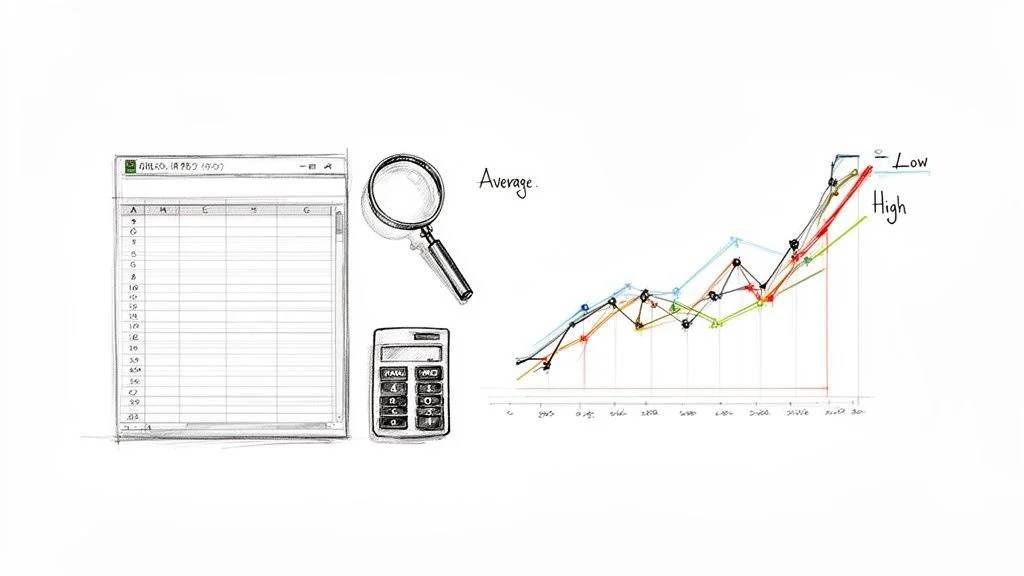
Raw scraped data is always messy. Before analysis, clean it: remove duplicate listings (if scraping daily, you'll have multiple snapshots of the same item), strip currency symbols from prices, and standardize formatting. This takes 5 minutes in Google Sheets.
The Three Calculations That Matter
- Average price — your market baseline. Use =AVERAGE() on the price column. This is what "normal" looks like.
- Min and max prices — =MIN() and =MAX() show the floor and ceiling. If you're above max, you're losing sales. If you're below min, you're leaving margin on the table.
- Price distribution — a histogram chart shows where most sales cluster. Often, the actual sales sweet spot is below the average but above the floor.
Example: a vintage band tee shows an average price of $35, but a histogram reveals most sales cluster between $28–$32. That's where you should price — not at the average, and not at the optimistic $45 that rarely sells.
Advanced: Track Variations, Not Just Products
A common mistake is tracking a product at a high level — "Nike Air Force 1" — and missing the variation-level data where the real profit is hiding. A size 11 in a limited colorway has a completely different market value than a common size 9 in all-white. Make sure your tracker captures size, color, condition, and bundle details for every listing.
Frequently Asked Questions
Is tracking eBay prices legal?
Yes. Tracking publicly available prices on eBay is 100% legal and standard practice in e-commerce. Every time you browse a listing you're looking at the same data — an automated tracker just does it faster and at scale. These tools don't access private accounts or non-public data.
How often should I check eBay prices?
Match your frequency to how fast your market moves. Fast-moving items (electronics, hyped sneakers) warrant daily checks — prices can swing significantly within 24 hours. Standard categories (books, auto parts) need weekly checks. High-ticket collectibles are fine with monthly snapshots for seasonal trend analysis.
Can I track prices on international eBay sites?
Yes. You can point a browser-based tracking tool at ebay.co.uk, ebay.de, ebay.com.au, or any other regional site. Data comes back in local currency, which you can convert to your home currency with a simple formula in Google Sheets. This is a powerful way to uncover global pricing gaps and arbitrage opportunities.
Will eBay block my price tracker?
Aggressive server-side scrapers that hammer eBay with rapid requests risk IP blocks. Browser-based tools like Clura run inside your own browser session, making their activity virtually indistinguishable from normal browsing. Keep your tracking frequency reasonable (not scraping every minute) and use tools with built-in human-like delays.
What's the difference between tracking auctions and Buy It Now listings?
Buy It Now listings give you the fixed market price — track price, shipping costs, and sales velocity for competitive analysis. Auctions reveal buyer demand and bidding behavior — track current bid, number of bidders, and time remaining. BIN listings typically outsell auctions by 45% and produce 15% higher final prices when tracked over several weeks, making them the better signal for pricing strategy.
How do I use price tracking to find profitable flipping opportunities?
Track sold listings (not just active listings) to find the real market value of items. When you see a gap between what items are listed for and what they actually sell for, that's an opportunity. Also watch for inventory drops — when competitors sell out, prices rise. If you're already stocked, that's a window to raise your price and capture extra margin.
Conclusion
An eBay price tracker is one of the highest-ROI tools you can add to your e-commerce workflow. For sellers, it means never pricing from guesswork again. For resellers and flippers, it reveals the profit opportunities that manual browsing always misses.
Start simple: set up a weekly scrape of your main competitors for your top 5 SKUs. Calculate average, min, and max prices. Adjust your listings accordingly. Once you see the impact, expanding to daily monitoring and sold listings tracking is a natural next step.
Explore related guides:
- eBay Web Scraping: The Complete Guide — the full guide to extracting any data from eBay automatically
- Web Scraping for Lead Generation — apply the same automation to build B2B lead lists
- What Is Market Intelligence — how to turn scraped data into a strategic business advantage
- What Is Data Enrichment — enrich raw eBay data with additional context and signals
Stop Guessing — Start Tracking eBay Prices Automatically
Clura monitors any eBay search or listing on a schedule and exports clean, structured price data. Find deals, catch competitor moves, and price for profit — without manual checking.
Add to Chrome — Free →