
What Is Market Intelligence?
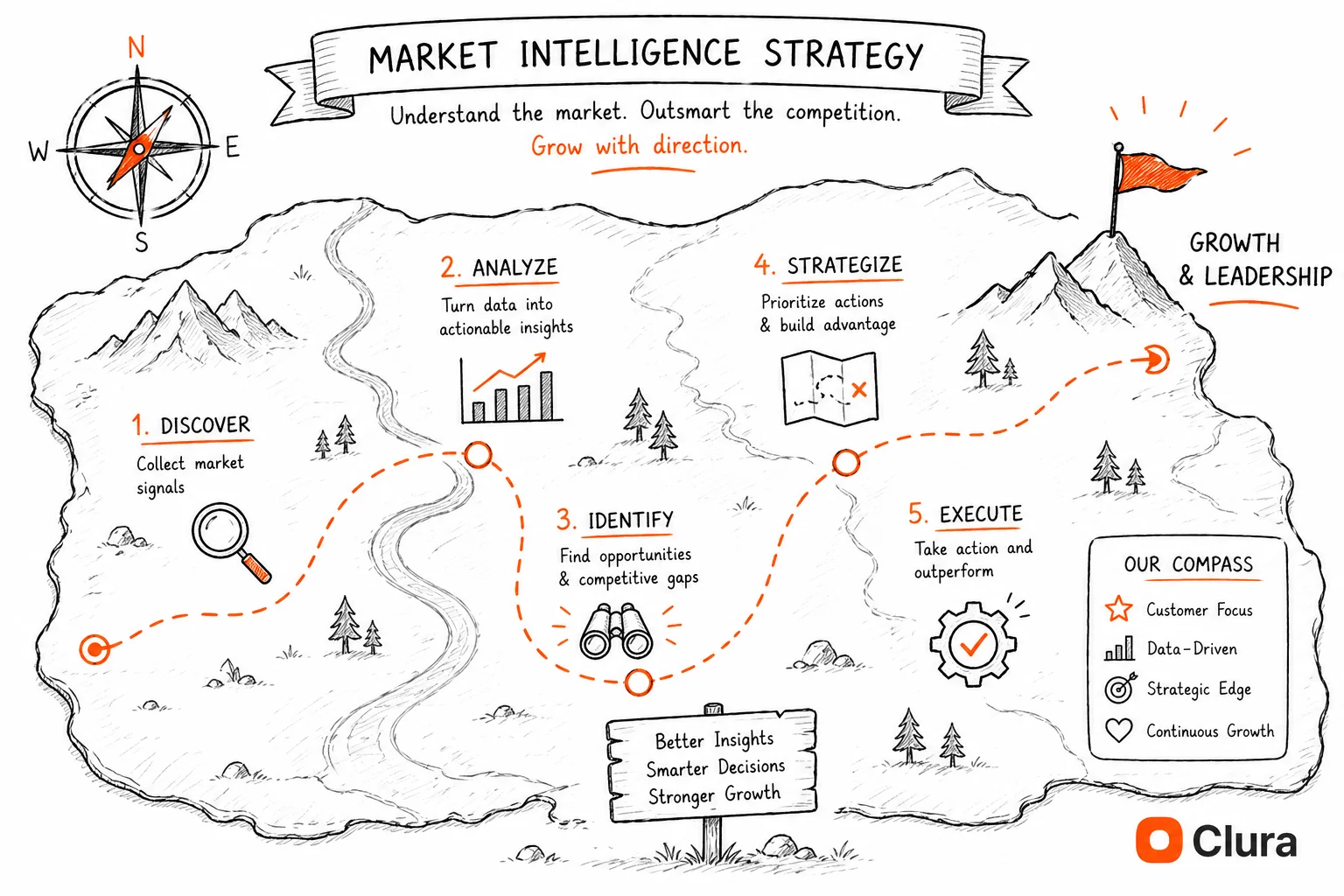
Market intelligence is the process of collecting and analyzing data about your industry, competitors, customers, and market trends to make better decisions. It's your business's real-time GPS — showing where competitors are, what customers are thinking, and the clearest path to growth.
The global market intelligence industry was valued at USD 12.1 billion in 2024 and is projected to hit USD 21.4 billion by 2031. This guide covers the four pillars, the five-step workflow, and real use cases for every team — from sales and marketing to e-commerce and HR. See also our guide on the best competitor analysis tools for the platforms that power modern market intelligence.
Turn the Web into Your Market Intelligence Feed
Clura's AI Chrome extension scrapes competitor prices, customer reviews, job postings, and lead data from any public website — delivering real-time market intelligence without manual research.
Add Clura to Chrome — Free →What Is Market Intelligence and Why It Matters
Market intelligence is the process of collecting and analyzing data about your industry, competitors, customers, and market trends to make better business decisions — distinct from business intelligence because it focuses on external forces rather than internal company data.
This isn't about dusty, static reports outdated the moment they're printed. True market intelligence is a live feed — tracking a competitor's sudden price drop, a subtle shift in customer sentiment, or an emerging market trend. It's about knowing what's coming before it happens.
- Spot Emerging Trends: See new opportunities before they go mainstream and get a head start.
- Find Hidden Gaps: Uncover untapped markets or discover weaknesses in competitors' offerings.
- Anticipate Threats: Foresee competitive moves or market shifts and prepare your strategy in advance.
- Understand Your Customers: Gain deep insights into what your audience actually wants.
Market intelligence provides the essential external view — understanding both your competition and the wider market so you can position for success. It's about being proactive, rather than just reacting to others' moves.
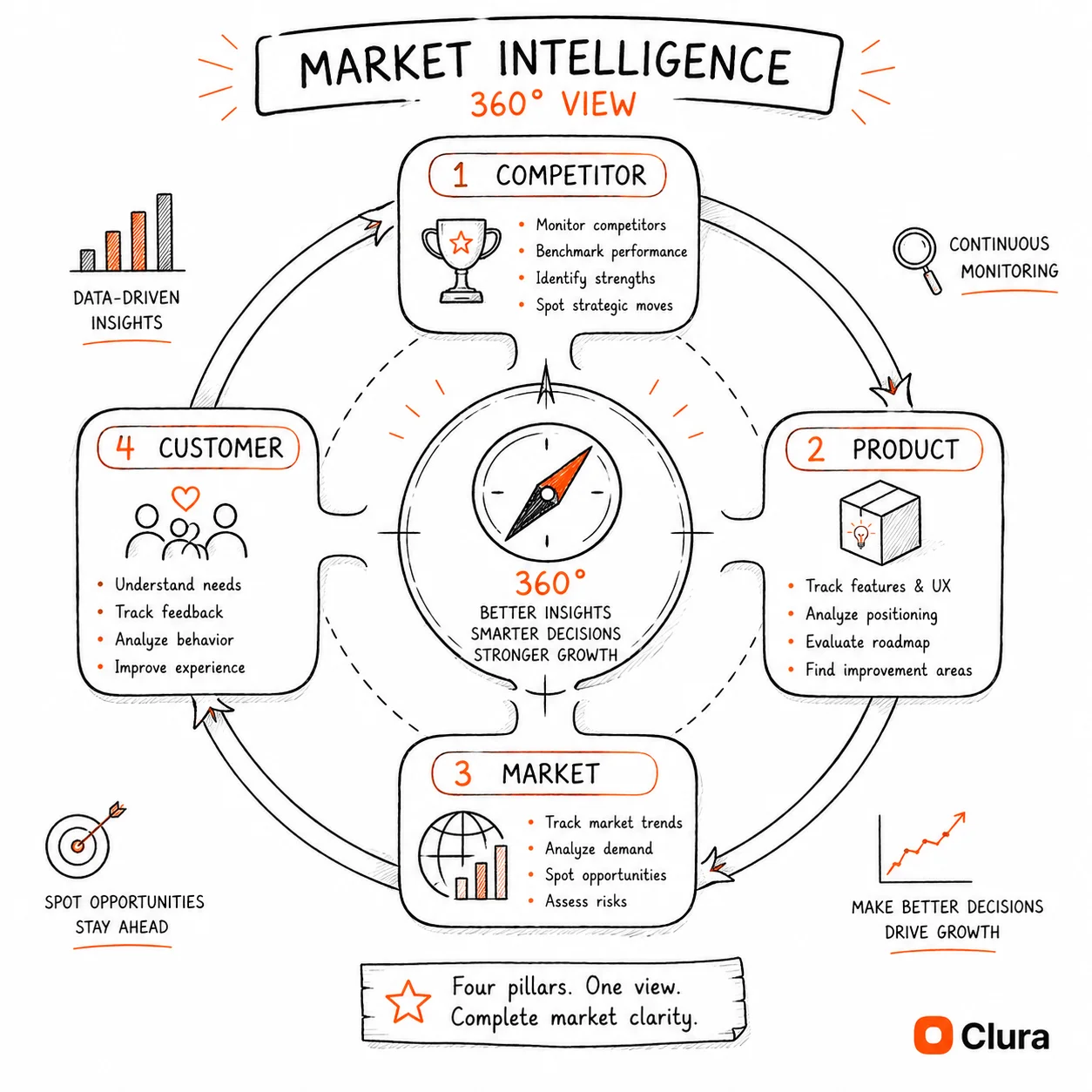
The Four Pillars of Modern Market Intelligence
Modern market intelligence rests on four pillars: competitor intelligence (tracking rivals' moves and strategy), product intelligence (deep-diving into competing products' features and reviews), market understanding (analyzing broad industry and economic trends), and customer understanding (learning what motivates and frustrates your target audience).
1. Competitor Intelligence
Ethically gathering information on who you're competing against, what they're doing, and what their next move might be. Track new product launches, pricing changes, marketing messages, and hiring signals. New job postings can reveal strategic priorities before they're public.
2. Product Intelligence
A deep dive into competitors' product features, performance, pricing, and — most importantly — user reviews. This is where you find innovation opportunities and gaps customers desperately want filled. Check reviews on G2, Capterra, or the App Store.
3. Market Understanding
Zoom out to analyze broad industry and economic trends affecting everyone in your space — new regulations, supply chain issues, emerging tech, and changes in buyer behavior. This macro-level view makes a business resilient and relevant long-term.
4. Customer Understanding
Getting inside the minds of the people you serve — their pain points, motivations, and behaviors — through social media listening, customer reviews, surveys, and direct feedback. When you genuinely understand your customers, everything else falls into place.
How to Gather Powerful Market Intelligence Data
Modern market intelligence data gathering combines primary sources (interviews, surveys, direct observation) with secondary sources (industry reports, government data, news) and AI-powered web scraping — which delivers real-time public data at scale without coding.
The internet is the single largest, most up-to-date database on the planet. Web scraping extracts public data from websites and organizes it into a clean, usable format — and today's AI-powered tools have opened the doors for everyone, no coding required.
| Data Type | Sources | Best For |
|---|---|---|
| Primary Data | Customer interviews, surveys, focus groups, direct observation | Deep audience insights and original research |
| Secondary Data | Industry reports, government data, news articles, press releases | Big-picture trends and macroeconomic perspective |
| AI Web Scraping | Competitor websites, LinkedIn, review sites, job boards | Real-time, scalable data at a fraction of the cost |
- Build Laser-Focused Lead Lists: Scrape LinkedIn or industry directories for hyper-targeted prospect lists.
- Monitor Competitor Pricing: Automatically track product prices on Amazon or Shopify to stay competitive.
- Spot Hiring Signals: Extract job postings to see where competitors are investing and growing.
- Analyze Customer Sentiment: Collect reviews from G2, Capterra, or the App Store to understand what people love and hate.
The US market research industry has grown to $36.4 billion in revenue — the value of timely data is clear. This empowers teams to be more agile and responsive, turning the live web into their ultimate source of market intelligence.
Automate Your Market Intelligence Data Collection
Clura scrapes competitors' prices, job postings, customer reviews, and lead data from any public website — delivering real-time insights without hours of manual research.
Add to Chrome — Free →Your Actionable Market Intelligence Workflow
The five-step market intelligence workflow is: define a specific goal, collect data with AI-powered tools, organize into a clean structured dataset, analyze for insights and patterns, then act on the intelligence with targeted outreach or strategic decisions.
| Step | Action | Example Tool/Method | Outcome |
|---|---|---|---|
| 1. Goal Setting | Define a specific target: 100 fintech SaaS companies in North America that recently hired a 'Head of Growth' | Internal Strategy Meeting | A clear, measurable objective for the sales team |
| 2. Data Collection | Scrape LinkedIn Sales Navigator for profiles meeting the criteria | Clura AI Agent | A raw CSV file with hundreds of potential leads |
| 3. Data Organization | Clean the CSV: remove duplicates, standardize job titles | Google Sheets or Excel | A clean, structured dataset ready for analysis |
| 4. Data Analysis | Enrich with company size and funding data; filter for 50–200 employees | Clay or manual research | A prioritized list of the top 100 most promising leads |
| 5. Action | Launch personalized email and LinkedIn outreach referencing the new hire | Outreach.io or HubSpot | Higher response rates and more booked meetings |
Market Intelligence Use Cases for Every Team
Market intelligence delivers concrete value across all teams: sales SDRs use it to build funding-triggered lead lists; marketers use it to identify competitor product weaknesses for campaign positioning; e-commerce teams use it for daily price monitoring; and recruiters use it to benchmark salaries and identify in-demand skills.
Sales: Funding-Triggered Lead Lists
SDRs use an AI-powered scraping tool to pull a daily list of companies from Crunchbase or PitchBook that just secured Series A funding — a major buying signal. Teams using this strategy see a 30% increase in meeting booking rates.
Marketing: Competitor Review Analysis
Scrape customer reviews for competing products from G2 and Capterra to spot the most common complaints. If data shows customers are consistently frustrated with a competitor's clunky UI, build a launch campaign around your product's superior ease of use.
E-commerce: Daily Price Monitoring
Set up a web scraping agent to automatically monitor competitor product pages daily — extracting product name, price, and stock status. Get an instant alert the moment a competitor changes a price, enabling immediate adjustments that protect market share.
Recruiting: Salary and Skills Benchmarking
Scrape job postings for similar roles from LinkedIn and Indeed to find the average salary range, most common benefits, and exact skills in demand. Armed with this data, adjust job descriptions and compensation to match the market — teams see a 40% increase in qualified applicants.
The Future of Market Intelligence with AI
AI is transforming market intelligence from backward-looking historical analysis to forward-looking predictions — with 78% of organizations using AI in 2024, up from 55% the year before — automating summary generation, predictive lead scoring, and real-time sentiment tracking.
AI flips the script on market analysis — instead of staring at spreadsheets of past data, AI processes millions of real-time data points to spot subtle patterns and generate forward-looking predictions. 78% of organizations reported using AI in 2024, a huge jump from 55% the year before.
- Automated Summaries: AI reads thousands of customer reviews and produces a one-page summary of key themes and overall sentiment.
- Predictive Lead Scoring: AI algorithms analyze countless signals to predict which leads are most likely to convert.
- Sentiment Tracking: Automated monitoring of brand perception — see our guide to social media sentiment analysis tools.
AI doesn't just give you a better rear-view mirror; it hands you a crystal ball. It's about anticipating market shifts, not just reacting to them after the fact.
Frequently Asked Questions
What is market intelligence?
Market intelligence is the process of collecting and analyzing data about your industry, competitors, customers, and market trends to make better business decisions. It focuses on the external world your company operates in — as opposed to business intelligence, which analyzes internal company data like sales figures and operational costs.
What's the difference between market intelligence and business intelligence?
Business intelligence (BI) looks inward — analyzing internal data like sales numbers, operational costs, and team performance to improve what you're already doing. Market intelligence (MI) looks outward — watching competitors, listening to customers, tracking industry shifts, and monitoring the economic big picture. You need both: BI tells you what is happening inside your company, MI tells you why it's happening in the context of the market.
How can a small business start with market intelligence?
Start lean with one specific goal — like 'track the prices of my top three competitors' or 'find 20 new sales leads on LinkedIn this week.' Use free tools like Google Alerts for competitor mentions. Then automate one key task: use a web scraping tool to automatically pull public data for you, like tracking new job postings on a competitor's site to see their expansion plans.
Is web scraping legal for market intelligence?
Yes — web scraping is legal for gathering publicly available data. If the information is accessible to anyone on the internet (not behind a login or paywall), it's generally fair game. Respect a website's robots.txt file and avoid overloading servers with too many requests. Good, modern scraping tools handle this responsibly.
What data sources should I collect for market intelligence?
Effective market intelligence combines primary data (customer interviews, surveys, direct observation), secondary data (industry reports, government data, news), and AI-powered web scraping (competitor prices, job postings, reviews, and lead data from LinkedIn and directories). The combination gives you both depth and real-time coverage.
Conclusion
Market intelligence is your business's competitive GPS — keeping you oriented, proactive, and ahead of shifts that catch reactive companies off guard. By understanding the four pillars (competitor, product, market, and customer intelligence) and following the five-step workflow, you build a system that consistently delivers actionable insights to every team.
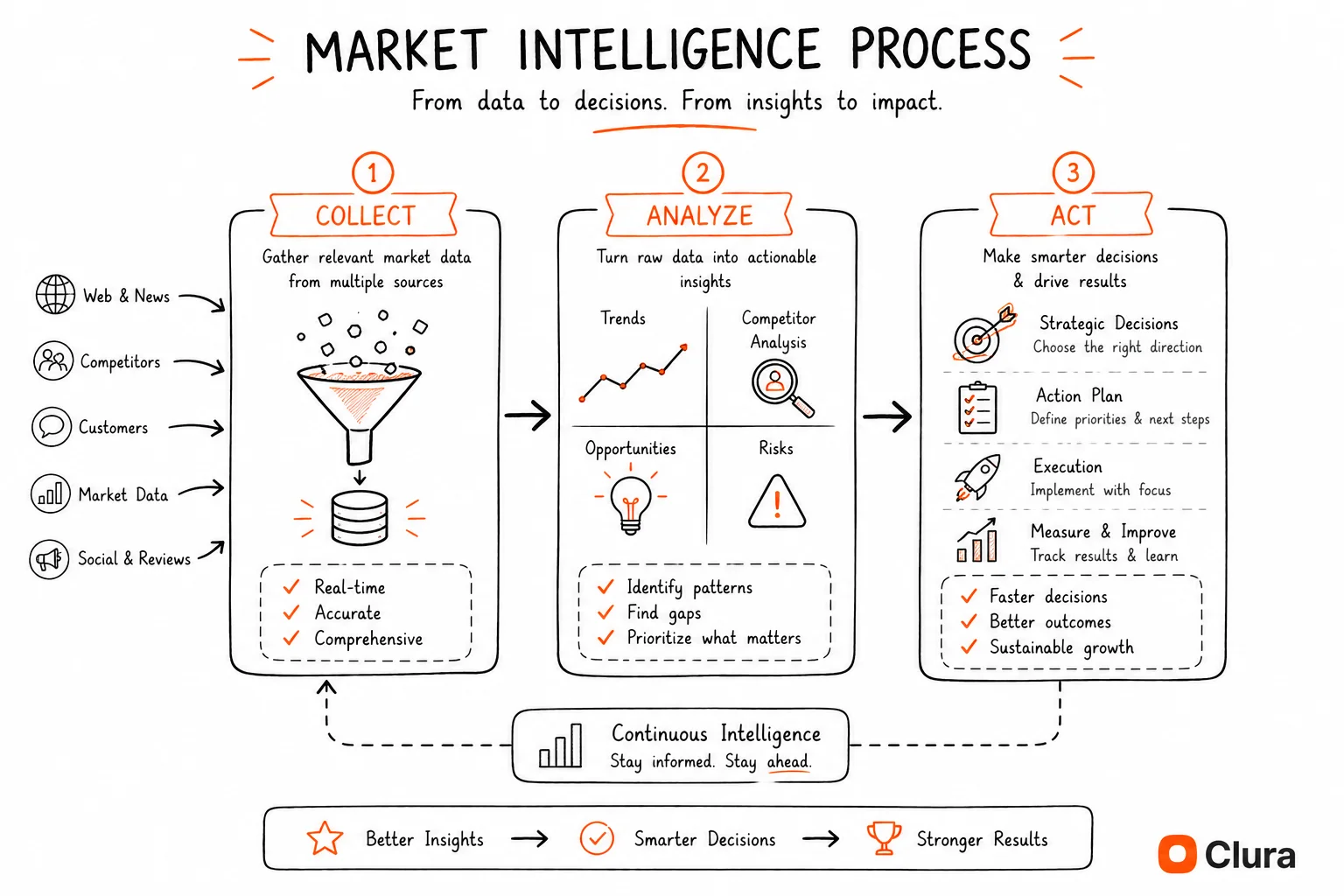
The best market intelligence isn't a quarterly report — it's a continuous loop of collecting real-time data, analyzing it for patterns, and acting on what you find. AI and automation make this loop faster and more powerful than ever.
Explore related guides:
- Best Competitor Analysis Tools — top platforms for tracking competitors across SEO, pricing, and content
- Social Media Sentiment Analysis Tools — automate brand and competitor sentiment monitoring across social platforms
- What Is Competitor Analysis in Marketing — the strategic framework behind effective competitive intelligence
Stop Manually Copying Data — Let AI Do the Heavy Lifting
Clura makes it simple to extract clean, structured market intelligence data from any website — competitor prices, customer reviews, job postings, and leads — no coding required.
Add to Chrome — Free →