
9 Marketing Automation Best Practices to Boost Your ROI
Clura Team
Marketing automation platforms can do far more than send emails on a schedule. Most teams barely scratch the surface. These 9 best practices transform automation from a basic email tool into a genuine revenue engine.
The companies achieving the highest returns treat marketing automation as an operating system — not a campaign tool. They connect lead scoring, behavioral triggers, sales alignment, and content strategy into a single, self-improving machine. Whether you are just getting started or optimizing an existing stack, these practices will help you generate more qualified leads and convert them faster.
Feed Your Automation Stack With Fresh, Accurate Lead Data
Clura extracts structured contact and company data from LinkedIn, websites, and directories — so your CRM stays clean and your automation workflows fire on the right people.
Add to Chrome — Free →1. Build a Lead Scoring and Segmentation System
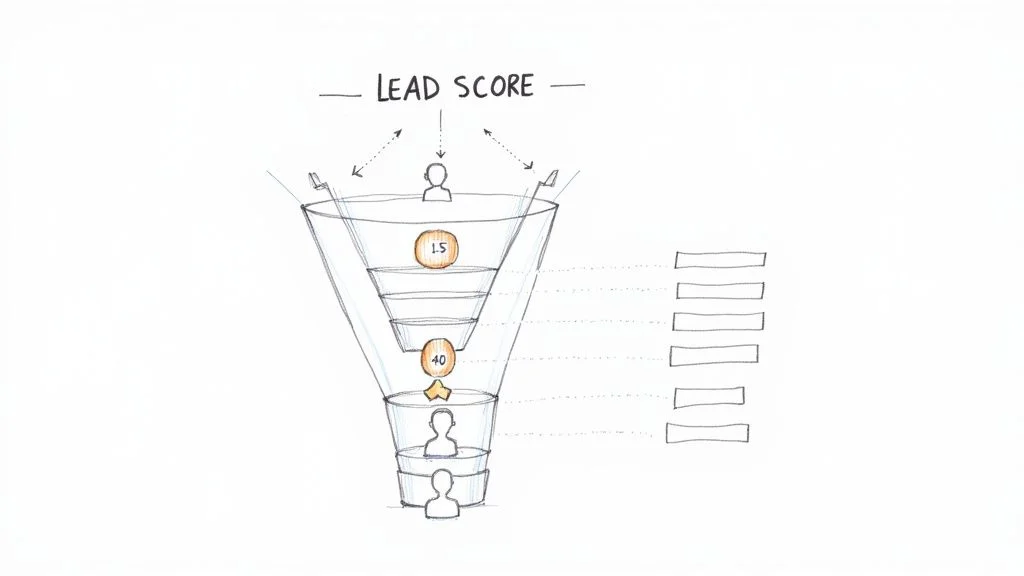
Lead scoring assigns numerical values to prospect behaviors and attributes, enabling your automation platform to prioritize high-intent leads and route them to sales before they go cold.
Not all leads are equal. Lead scoring lets you quantify intent by assigning points for actions like opening emails (+5), visiting the pricing page (+20), downloading a case study (+15), or matching your ideal customer profile attributes like company size and industry (+10 each).
Combine scoring with behavioral segmentation to group leads by lifecycle stage, industry vertical, product interest, and engagement level. Each segment gets its own nurture track — so a cold prospect from mid-market SaaS receives different messaging than a hot lead from an enterprise account who just watched your demo.
- Define a Marketing Qualified Lead (MQL) threshold score with your sales team
- Build negative scoring for disqualifying signals (e.g., student email domains, wrong geography)
- Review and recalibrate scores quarterly using closed-won and closed-lost data
- Use dynamic list segmentation so contacts automatically move between nurture tracks
2. Go Beyond First-Name Personalization
True email personalization in 2026 means dynamically adapting content based on lifecycle stage, behavioral triggers, and account-level firmographics — not just inserting a first name into the subject line.
Inserting {{first_name}} is table stakes. The automation platforms generating real revenue use conditional content blocks that change based on industry, lifecycle stage, last product interaction, or account health score.
Behavioral trigger emails consistently outperform batch-and-blast campaigns. Set up automated sequences for:
- Trial activation — send within 5 minutes of sign-up with a specific first-step CTA
- Feature adoption — trigger education emails when users skip key activation milestones
- Re-engagement — fire a win-back sequence when a contact goes 30 days without activity
- Milestone celebration — recognize usage anniversaries or expansion events
Dynamic content goes further by swapping out entire email sections based on contact properties. A customer in the financial services industry sees compliance-focused copy and case studies; a SaaS company sees integration-focused messaging.
3. Create a Sales and Marketing SLA
A Sales and Marketing Service Level Agreement (SLA) defines exactly what marketing promises to deliver to sales — in terms of lead volume and quality — and what sales commits to doing with those leads within a defined timeframe.
Companies with tightly aligned sales and marketing teams generate 208% more revenue from marketing efforts. The mechanism is an SLA: a formal agreement that specifies MQL-to-SQL handoff criteria, response time expectations, and the feedback loop that closes the loop on lead quality.
A basic Smarketing SLA includes:
- Marketing commits to delivering X MQLs per month meeting defined criteria
- Sales commits to following up on every MQL within 4 business hours
- Sales provides disposition feedback (Qualified, Not Qualified, Wrong Timing) within 5 business days
- Both teams review pipeline data in a shared weekly dashboard
The shared dashboard is critical. When marketing can see which leads converted to pipeline and which were immediately disqualified, they can iterate on targeting and messaging. When sales can see where leads came from and what content they engaged with, they can personalize outreach immediately.
4. Design Smart Workflows With Conditional Logic
Smart automation workflows use if/then branching logic to route contacts down different paths based on their behavior, profile data, or previous interactions — replacing linear drip sequences with adaptive nurture journeys.
Linear email sequences treat every contact the same. Smart workflows react to what a contact actually does. If they open email 1 but do not click, send a follow-up with a different angle. If they click to a pricing page, trigger an immediate sales alert. If they download a guide, enroll them in a product-specific nurture track. You can automate data extraction to keep your CRM enriched so conditional logic fires correctly.
- Start every workflow with a clear goal — a specific conversion event, not just 'nurture'
- Add wait steps calibrated to your sales cycle length, not arbitrary days
- Build A/B test branches directly into workflows to optimize subject lines and CTAs
- Set exit conditions so contacts leave a workflow when they convert or become customers
- Always include a suppression list to prevent over-emailing active sales conversations
Keep Your Workflows Firing on Fresh Data
Clura continuously extracts updated contact and company data from the web, so your lead records stay accurate and your automation triggers fire at exactly the right moment.
Add to Chrome — Free →Test every workflow before activating it. Send yourself through the full sequence, check every branch condition, verify that scoring updates and CRM field writes happen as expected.
5. Layer in Account-Based Marketing for B2B
Account-based marketing (ABM) flips the funnel by identifying high-value target accounts first and then orchestrating personalized marketing and sales motions specifically for the buying committee at each account.
B2B deals are won at the account level, not the contact level. ABM automation coordinates personalized touchpoints across every member of the buying committee — from the economic buyer to the technical evaluator to the end user — running in parallel rather than sequentially.
To build an ABM motion:
- Define your Ideal Customer Profile (ICP) with firmographic, technographic, and intent data
- Build a target account list of 50-500 accounts depending on deal size and sales capacity
- Map the buying committee at each account — identify at least 3-5 stakeholders per deal
- Create account-specific content: personalized landing pages, custom case studies, executive briefs
- Coordinate email, LinkedIn outreach, paid retargeting, and direct mail in a multi-channel sequence
Automation ties this together by triggering outreach sequences when an account reaches a defined engagement threshold — for example, 3 or more contacts from the same company visiting your pricing page within 7 days.
6. Map Automation to the Full Customer Lifecycle
Effective marketing automation covers every lifecycle stage — Awareness, Consideration, Decision, Onboarding, Expansion, and Advocacy — with tailored workflows for each, rather than focusing solely on pre-sale lead nurture.
Most teams use automation only for pre-sale nurture and then abandon it once a deal closes. The highest-performing teams apply automation across the full customer lifecycle. HubSpot's lifecycle stage marketing framework illustrates how different workflows apply at every stage from awareness through advocacy.
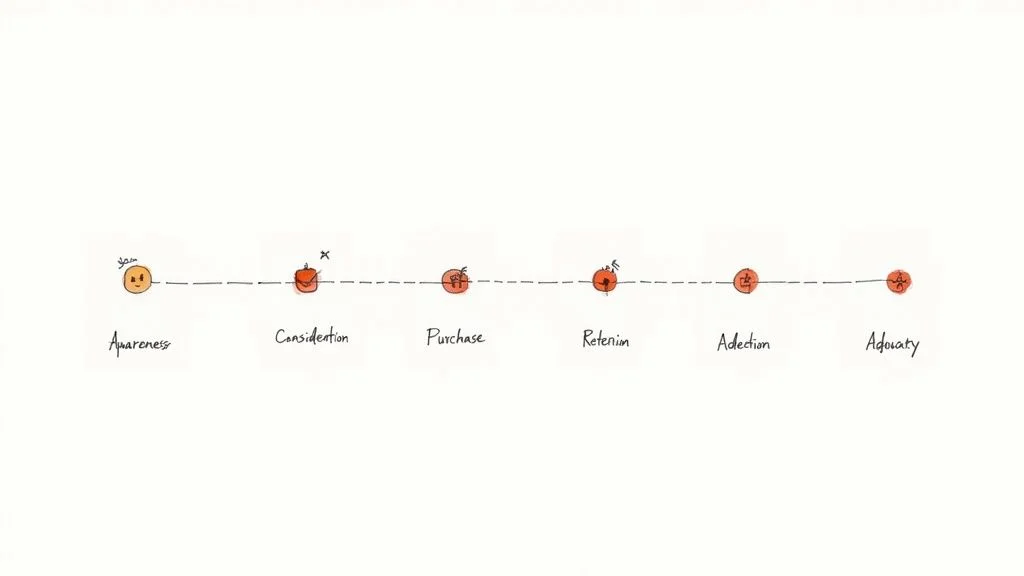
- Awareness: SEO-triggered content offers, retargeting pixel-based ad sequences
- Consideration: Comparison guides, case study drips, competitive battle cards
- Decision: Free trial or demo workflows, ROI calculator sends, executive outreach
- Onboarding: Activation sequences, in-app tooltips triggered by API events, success check-ins
- Expansion: Usage-based upsell triggers, cross-sell sequences, renewal campaigns
- Advocacy: NPS-triggered review requests, referral program invitations, community access
7. Measure Everything With Multi-Touch Attribution
Multi-touch attribution assigns revenue credit to every marketing touchpoint in a buyer's journey — not just the last click — giving you an accurate picture of which automation workflows and campaigns are actually driving pipeline.
Last-touch attribution makes your sales team look like heroes and makes your content team invisible. Multi-touch models — linear, time-decay, or custom algorithmic — distribute credit across every touchpoint that influenced a deal.
Build an attribution infrastructure that connects every automated touchpoint to revenue:
- Add UTM parameters to every link in every automated email and ad
- Connect your MAP to your CRM so campaign membership maps to opportunity source
- Use a data warehouse or BI tool to join marketing activity data with closed-won revenue
- Report on Cost Per MQL, MQL-to-SQL rate, and pipeline contribution per channel
- Review attribution monthly and adjust budget allocation based on what is actually working
The goal of attribution is not to declare a winner — it is to understand which combination of touchpoints and sequences produces the fastest, most efficient path to revenue so you can do more of it.
8. Match Content to Every Buyer Stage
Content-led nurturing delivers the right asset at the right moment in the buyer journey — mapping top-of-funnel educational content to awareness, comparison content to consideration, and proof content to decision — maximizing the chance each email drives a meaningful next step.
Great automation with mediocre content still underperforms. Content-led nurture sequences map specific assets to specific lifecycle moments. A prospect who just downloaded a beginner guide needs education, not a pricing page link. A prospect who attended a product demo needs social proof and a clear trial CTA. Connect this to your pipeline-building strategy with our guide on how to build a sales pipeline.
- Top of funnel: How-to guides, industry reports, checklists, podcast episodes
- Middle of funnel: Case studies, comparison guides, webinar recordings, ROI calculators
- Bottom of funnel: Free trials, demos, competitive teardowns, executive business reviews
Gate your highest-value middle-funnel assets — case studies, in-depth research reports — to capture contact data and trigger enrollment into a nurture sequence. Use ungated content at top-of-funnel to build SEO traffic and retargeting audiences. Integrate content performance data back into lead scoring so high-intent content consumption accelerates a contact toward MQL status.
9. Orchestrate a Consistent Omnichannel Experience
Omnichannel automation ensures that every touchpoint a prospect encounters — email, LinkedIn, paid ads, SMS, in-app — delivers a consistent, coordinated message that advances them toward a buying decision rather than contradicting or repeating previous interactions.
Omnichannel does not mean being everywhere at once. It means that when a prospect opens your email and then sees a LinkedIn ad an hour later, both touchpoints feel like part of the same coherent conversation. Research on marketing automation ROI consistently shows that omnichannel programs outperform single-channel automation by a wide margin.
Start by connecting a Customer Data Platform (CDP) or your CRM to your MAP so that behavioral signals from one channel update contact records and suppress or trigger sequences in others. Then:
- Pick 2-3 core channels first — typically email + LinkedIn + retargeting ads — and nail the handoffs
- Suppress paid ads to contacts currently in active sales conversations
- Sync CRM opportunity stage to ad audience lists so messaging matches deal stage
- Gradually add channels (SMS, direct mail, in-app) once core orchestration is working
The best omnichannel programs feel like a single smart conversation to the buyer — not a series of disconnected blasts from different departments.
Frequently Asked Questions
How do I get started with marketing automation?
Start by identifying one high-value workflow to automate — typically a lead nurture sequence for your top conversion path. Choose a MAP that integrates with your CRM, define your MQL criteria, and build a simple 5-email nurture sequence before expanding. Complexity should grow with results, not before them.
What ROI should I expect from marketing automation?
Well-implemented marketing automation typically delivers 14.5% increases in sales productivity and 12.2% reductions in marketing overhead, according to Nucleus Research. Most teams see positive ROI within 6-12 months, with the highest returns coming from lead scoring, behavioral triggers, and sales-marketing alignment initiatives.
How do I align sales and marketing with automation?
Create a formal SLA that defines MQL criteria, handoff timing, and the feedback loop. Build a shared dashboard both teams review weekly. Use your MAP's CRM integration to give sales reps full context on a lead's marketing history — every email opened, every page visited — before they make their first call.
What is the best marketing automation platform for small businesses?
HubSpot Marketing Hub, ActiveCampaign, and Mailchimp are the most popular starting points for small businesses. HubSpot offers the deepest CRM-MAP integration and a generous free tier. ActiveCampaign leads on advanced automation logic and email deliverability. Mailchimp is the simplest entry point for email-focused teams.
Conclusion
Marketing automation rewards teams that treat it as a system, not a set of one-off campaigns. The nine practices above — from lead scoring and behavioral personalization to ABM and omnichannel orchestration — compound on each other when implemented together.
The highest-ROI investments are almost always in data quality and lead scoring first, because every other practice depends on accurate, up-to-date contact and account information. Start there, prove the model, and then systematically layer in the remaining practices.
Automation does not replace the human elements of great marketing — storytelling, empathy, creative — but it makes those human elements available at a scale and speed no manual process can match.
Explore related guides:
- LinkedIn Lead Generation Strategies — Proven tactics for generating B2B leads from LinkedIn in 2026
- How to Build a Sales Pipeline — A step-by-step framework for building and managing a predictable pipeline
- Automate Data Extraction — How to automate lead and market data extraction with no-code tools
Power Your Automation With Accurate, Real-Time Lead Data
Clura extracts fresh contact and company data from LinkedIn, websites, and directories directly in your browser — keeping your CRM clean so your automation workflows always fire on the right people.
Add to Chrome — Free →About the Author