
How to Do Market Research for a Small Business: 5 Steps
Clura Team
Market research for a small business boils down to five steps: define your goal, pick your methods, gather data, analyze findings, and build an action plan. With 73% of small businesses operating online and 62% of consumers struggling to choose between similar products, data-driven decisions are no longer optional.
The good news: you do not need a big budget or a research team. Modern tools — from free surveys to AI-powered web scrapers — give small businesses access to the same quality of market intelligence that large enterprises pay thousands for. This guide walks you through the full framework, with practical tool recommendations at each step. You can also explore our dedicated guide on what is market intelligence for a broader strategic context.
Automate Your Competitor Research in Minutes
Clura extracts pricing, product data, and customer reviews from competitor websites directly in your browser. Build a complete competitive intelligence picture without spending hours on manual research.
Add to Chrome — Free →Why Market Research Is a Game-Changer for Small Businesses
Market research gives small businesses the competitive intelligence to make decisions based on real customer needs and market conditions rather than assumptions, reducing the risk of product-market mismatch and wasted marketing spend.
Small businesses that invest in market research are 2x more likely to grow their revenue year over year, according to industry studies. Research does not need to be expensive or time-consuming — even simple, free methods like customer interviews and Google Trends analysis deliver significant insights.
Here is a comparison of the most common market research methods by cost and output:
| Method | Cost | Output Type |
|---|---|---|
| Surveys | Low | Scalable quantitative data |
| Interviews | Low-Medium | Deep qualitative insight |
| Focus Groups | Medium-High | Group dynamics and reactions |
| Secondary Research | Low | Fast existing data |
| Web Scraping | Low-Medium | Real-time competitor data |
Web scraping deserves special attention for small businesses on tight budgets. While a traditional market research firm might charge $5,000 for a competitive analysis, a no-code scraping tool lets you collect the same competitor pricing, product, and review data yourself in an afternoon.
Step 1: Define Your Research Goals
The most important step in market research is defining a specific, measurable question you want answered — because vague goals produce vague insights that no one acts on.
Before collecting a single data point, define exactly what decision this research needs to inform. Use the SMART framework: Specific, Measurable, Actionable, Relevant, Time-bound.
Examples of strong research questions:
- What is the price range customers in our market expect to pay for a mid-tier service package?
- Which three features are most important to first-time buyers in our category?
- How do we compare to our top three competitors on delivery speed and product quality?
- What reasons do customers give for choosing a competitor over us?
Focus on 1-2 critical questions per research cycle. Trying to answer too many questions at once leads to superficial data collection and analysis paralysis. Define your scope, identify who you are researching (existing customers, target segment, competitor customers), and set a deadline for completing the research.
Step 2: Choose Your Research Methods
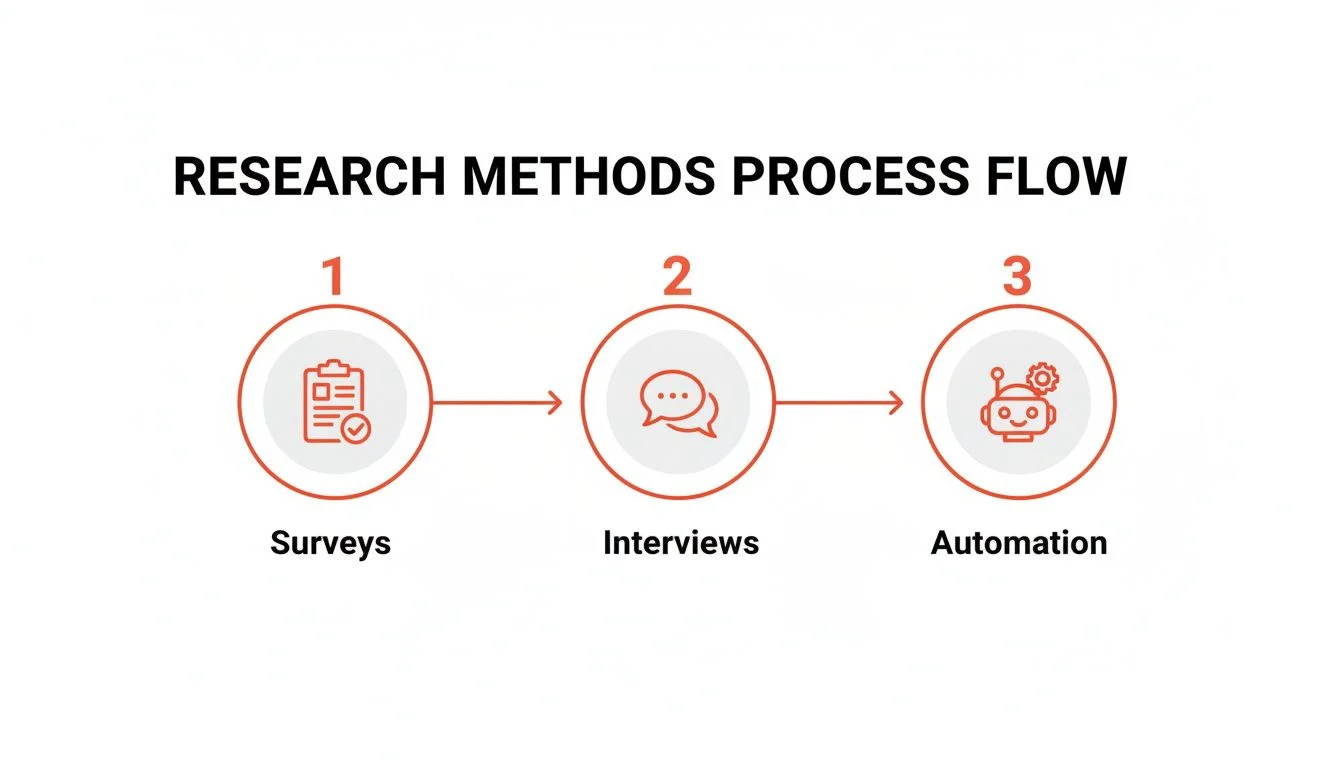
Small businesses typically get the best return from a combination of primary research (surveys and interviews for customer voice data) and secondary research automation (web scraping and trend tools for competitive and market data).
Primary research (data you collect directly) gives you customer voice. Secondary research (existing data you aggregate) gives you market context. The most effective small business research programs use both.
Here is a recommended tool stack by research type:
| Research Type | Recommended Tools |
|---|---|
| Surveys | Google Forms / Typeform |
| Interviews | Zoom / Calendly |
| Web Data | Clura |
| Search Trends | Google Trends / AnswerThePublic |
| Analysis | Google Sheets / Airtable |
For competitor analysis, web scraping automates the collection of pricing, product listings, and customer reviews from competitor websites — data that would take hours to collect manually. Combine with Google Trends to understand search demand patterns in your market, and Google Forms for free customer surveys. See our curated list of market research tools for startups for deeper tool comparisons.
Automate Your Competitor Research Today
Use Clura to extract competitor pricing, product data, and reviews from any website in minutes. No code, no subscriptions to external data vendors — just your browser and a click.
Add to Chrome — Free →Step 3: Collect Your Data
For primary research, prioritize quality over quantity — 20 thorough customer interviews yield more actionable insight than 200 superficial survey responses. For secondary research, automate wherever possible to eliminate manual data entry and scale your coverage.
Primary data collection tips:
- Keep surveys to 5-7 questions maximum — response rates drop sharply beyond that
- Use open-ended questions for qualitative insight: 'What almost stopped you from buying?'
- Record customer interviews (with permission) and transcribe for exact language
- Offer an incentive for survey completion: a discount code, a report, or a gift card
For secondary research automation, a web scraping workflow for competitor analysis looks like this: identify 3-5 direct competitors, use a tool like Clura to extract their product listings and pricing, pull their most recent customer reviews from G2 or Google, and schedule a weekly re-run to track changes over time.
Step 4: Analyze Your Findings
Analysis converts raw data into actionable insights by identifying patterns, gaps, and competitive opportunities — typically using a combination of SWOT analysis, competitive matrix comparison, and customer sentiment clustering.
Start with a competitive matrix to visualize where you stand versus alternatives. Here is an example for a local coffee shop comparing three competitors on key dimensions. For a structured framework, see our free competitor analysis template:
| Factor | Your Shop | Competitor A | Competitor B |
|---|---|---|---|
| Average Price | $4.50 | $5.00 | $3.75 |
| Ambiance Rating | 4.2/5 | 4.8/5 | 3.5/5 |
| Google Reviews | 4.4 (312) | 4.7 (891) | 4.0 (124) |
| Unique Offering | Specialty beans | Live music | Drive-through |
Layer a SWOT analysis on top of the competitive matrix to identify strategic implications. For survey and interview data, group responses into themes: cluster similar answers to open-ended questions and count frequency. The themes that appear most often are the ones worth acting on.
Step 5: Build Your Action Plan
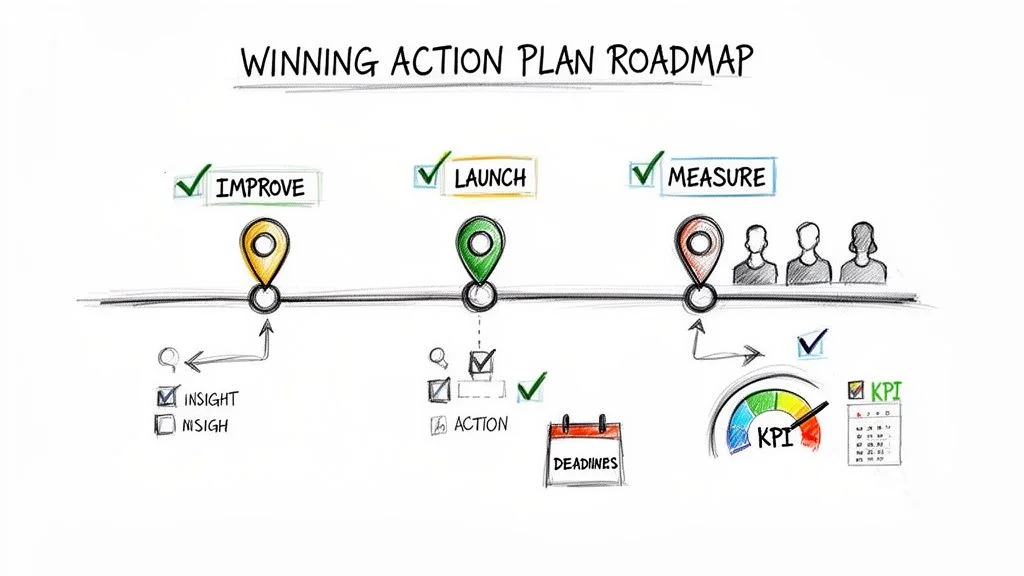
Market research only creates value when it drives decisions — convert each key insight into a specific goal, initiative, and owner with a measurable KPI and deadline.
Research without action is expensive trivia. For each major insight, build a one-row action plan with the following structure:
| Key Insight | Goal | Initiative | Owner | Timeline | KPI |
|---|---|---|---|---|---|
| Competitor offers 2-day shipping | Match shipping speed | Negotiate 3-day carrier deal | Ops lead | Q2 2026 | Avg delivery time |
Prioritize initiatives by impact and effort. High-impact, low-effort wins should go first. Share findings with your full team — insights locked in a research deck no one reads generate zero ROI. A 15-minute team presentation with three key takeaways and three action items is more valuable than a 50-page report.
Frequently Asked Questions
How much should a small business spend on market research?
A common guideline is 1-2% of annual revenue for market research, but many small businesses get excellent results for free or near-free using Google Forms, Google Trends, and no-code web scraping tools. The most important investment is time — 10 customer interviews and a week of competitor monitoring will tell you more than most expensive research reports.
How often should a small business do market research?
Plan for an annual deep-dive research cycle (4-6 weeks) to review your full competitive landscape and customer needs, quarterly pulse checks (2-3 customer interviews plus a competitor pricing scan), and always-on monitoring using automated tools to track competitor changes and search trends continuously.
What is the biggest market research mistake small businesses make?
Two mistakes dominate: not doing any research at all (relying entirely on gut feel), and asking leading questions in surveys that confirm existing beliefs rather than challenging them. Great research starts with genuine curiosity about what customers actually think — not validation of what you already believe.
Conclusion
Market research for a small business does not require a big budget or a dedicated research team. The five-step framework — define goals, choose methods, collect data, analyze findings, build an action plan — works whether you are a solo founder or a 50-person team.
The biggest competitive advantage available to small businesses in 2026 is speed: the ability to collect fresh competitive and customer data quickly, draw clear conclusions, and act on them before larger competitors finish their quarterly planning cycle.
Start with one clear research question, one primary method, and one secondary data source. Run the cycle in two weeks. Then expand from there.
Explore related guides:
- What Is Market Intelligence — How to build a continuous market intelligence system for your business
- Market Research Tools for Startups — The best free and paid market research tools for lean teams
- Competitor Analysis Template — A free, ready-to-use competitive analysis framework
Get Ahead of Your Competition With Real-Time Market Data
Clura extracts competitor pricing, product listings, and customer reviews from any website in minutes. Start your competitive research today — no credit card required.
Add to Chrome — Free →About the Author