
Your Ultimate Guide to Competitor Price Monitoring Software
Clura Team
Competitor price monitoring software automates the entire process of collecting, organizing, and analyzing what your rivals are charging — giving you an always-on market intelligence system that replaces guesswork with hard data. Research shows 37% of shoppers say the ability to compare prices online is the main reason they choose where to buy. These tools give you the same market awareness your customers already have, but at massive scale.
This guide covers how price monitoring software works under the hood, the must-have features that separate strategic tools from basic price checkers, a simple five-step workflow to get automated competitor tracking running in minutes, and the strategies that turn raw pricing data into genuine competitive advantage. For a broader look at tracking strategy, our guide on online price tracking covers complementary approaches.
Start Monitoring Competitor Prices in One Click
Clura’s AI browser agent automatically extracts pricing, stock status, and product data from any e-commerce site — no code required. Set up a scheduled workflow and get fresh competitor data delivered automatically every morning.
Add to Chrome — Free →What Is Price Monitoring and Why It’s a Game Changer
Competitor price monitoring software automates the collection and analysis of rival pricing data across hundreds of products and sites simultaneously — replacing manual spot-checks with real-time intelligence that lets you react to market changes in minutes instead of days.
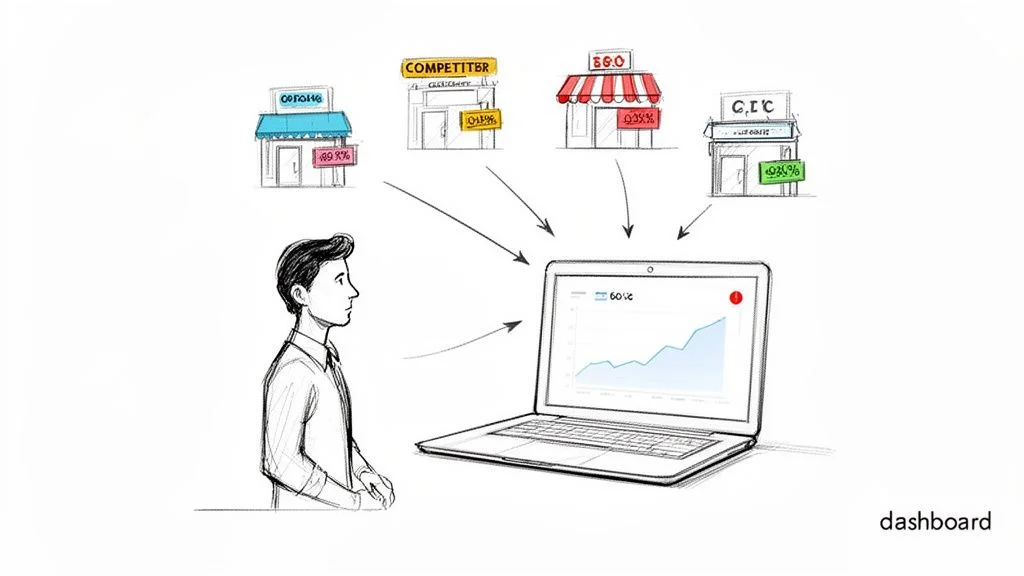
This technology empowers you to shift from just reacting to price changes to building proactive, data-driven strategies that protect your margins and fuel real growth.
Manual competitor price checking is a losing game. You check one site, then another, then another — and by the time you finish, prices have already changed again. Automated price monitoring flips this dynamic entirely. Instead of chasing the market, you see it in real time.
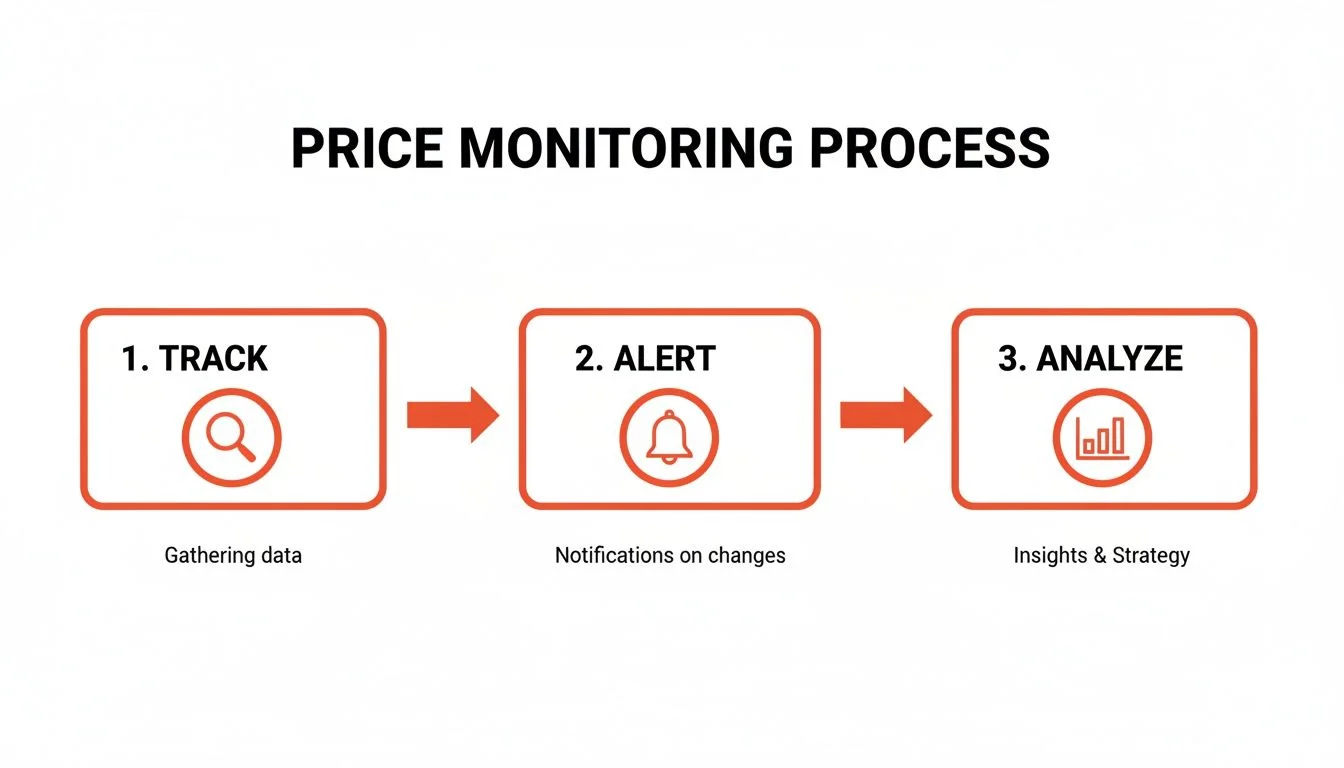
- Stay agile: get instant alerts when a competitor launches a sale, drops a price, or runs out of stock
- Protect margins: know exactly when to hold firm and when a strategic adjustment makes sense
- Make confident decisions: use hard data to build better promotions, set launch prices, and manage product lifecycle
How Price Monitoring Software Does the Heavy Lifting
Competitor price monitoring software operates in three phases: automated web scraping bots collect raw price data 24/7, AI-powered product matching ensures you are always comparing identical items across different naming conventions, and a centralized dashboard transforms the raw data into clear business intelligence.
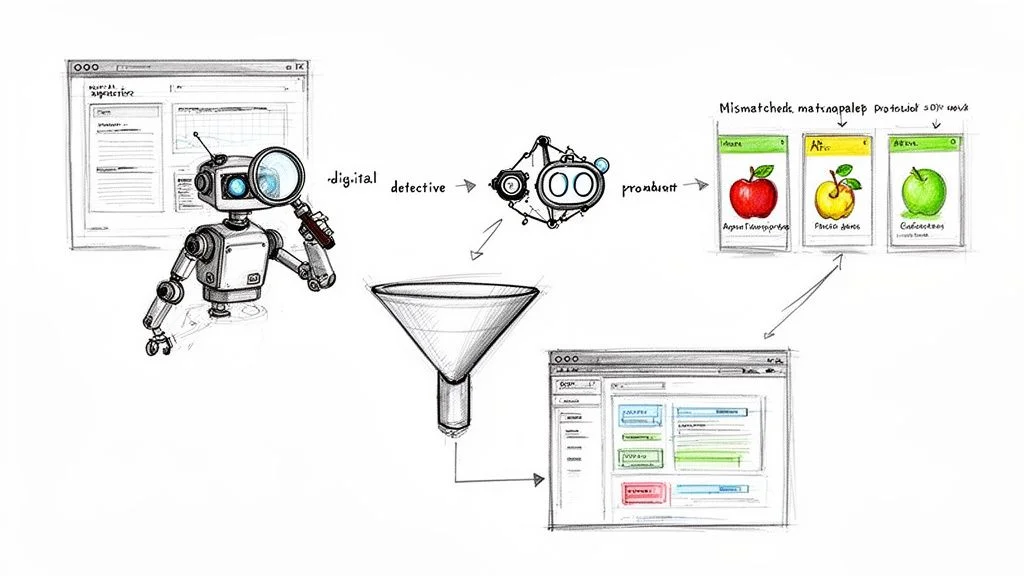
The Automated Data Collection Engine
Specialized bots navigate competitor websites like a person, zeroing in on product pages to grab prices, stock status, and promotional data. These bots run 24/7 — while a person might check a few key competitors each morning, an automated system can monitor hundreds every few minutes, turning a reactive pricing strategy into a proactive market-leading one.
Making Sense of the Noise with AI
AI-powered product matching ensures you are always comparing apples to apples. It understands that a “Men’s Athletic Sneaker, Size 10, Blue” on one site is the same product as a “Blue Running Shoe - M 10” on another — even when names and SKUs do not match perfectly. This matching is the secret sauce: without it, you are just looking at a jumble of numbers.
Accurate product matching eliminates costly errors and gives you the confidence to make decisions based on rock-solid data.
From Chaos to Clarity in One Dashboard
With data collected, cleaned, and matched, a centralized dashboard transforms raw numbers into genuine business intelligence. Modern browser-based AI agents have made this kind of market-monitoring power accessible to businesses of any size — not just mega-corporations. This capability is also a hallmark of the best data extraction software on the market.
Must-Have Features in Your Price Monitoring Toolkit
The six non-negotiable features in effective competitor price monitoring software are real-time tracking, automated alerts, historical pricing data, AI-powered product matching, a dynamic pricing engine, and visual dashboards that transform raw data into actionable intelligence.
| Feature | What It Does | Why You Need It |
|---|---|---|
| Real-Time Data Scraping | Continuously scans competitor sites for price and stock updates | Ensures decisions are based on current market reality, not old news |
| Automated Alerts | Sends instant notifications based on pre-set triggers (price drops, stock changes) | React instantly to competitor moves without constant manual checking |
| Historical Data | Stores past pricing, stock, and promotion data for trend analysis | Unlocks strategic insights into competitor patterns and seasonality |
| AI Product Matching | Automatically links your products to identical ones on competitor sites | Eliminates manual matching work and ensures apples-to-apples comparisons |
| Dynamic Pricing Engine | Suggests or automates price adjustments based on rules and market data | Helps stay competitive and maximize margins without constant manual repricing |
| Visual Dashboards | Presents data in easy-to-understand charts, graphs, and reports | Turns raw data into actionable intelligence you can understand and act on quickly |
Put Your Price Monitoring on Autopilot with a Simple Workflow
A complete competitor price monitoring workflow runs in five steps: identify your top 3-5 competitors and key products, navigate to their product pages, launch an AI agent to extract pricing data in one click, export organized data to a spreadsheet, and schedule the entire process to repeat automatically.
- Pinpoint your targets: focus on 3-5 direct competitors and a handful of key products that compete with your bestsellers
- Navigate to a product page: open the competitor product page you want to track in your browser
- Unleash the AI agent: click the Clura extension icon — the AI scans the page and extracts prices, titles, and stock status in one click
- Organize and export: download the structured data as a spreadsheet with clean rows and columns, ready for comparison
- Set it and forget it: schedule the workflow to run automatically — daily, weekly, or hourly — for continuous monitoring
Automate Your Competitor Price Monitoring Today
Clura’s AI agent extracts pricing and product data from any e-commerce site in one click. Schedule it to run automatically and wake up every morning with fresh competitor intelligence ready to act on.
Add to Chrome — Free →Turn Pricing Data Into Winning Strategies
Competitor pricing data drives four powerful strategies: dynamic repricing rules that keep you automatically competitive, MAP policy enforcement through instant violation alerts, smarter promotion timing based on historical competitor patterns, and finding market gaps when rivals run out of stock on popular items.
Embrace Dynamic Pricing
With a constant stream of competitor data, you can create rules that automatically adjust your prices. Slightly lower a price to match a key competitor’s sale, or raise your price to maximize margin when a rival runs out of stock. It is a proactive strategy that keeps you perfectly positioned 24/7 without constant manual attention.
Enforce Your MAP Policies
If you are a brand, your Manufacturer’s Advertised Price (MAP) policy is crucial for protecting brand value. Automated monitoring sets up instant alerts the moment a retailer drops below your MAP, letting you enforce agreements quickly and consistently — protecting brand integrity and relationships with honest retail partners.
The global competitor price monitoring software market is projected to surge from $1,129.5 million in 2025 to $2,500 million by 2035. Smart repricing can boost margins by 5-10%, according to industry benchmarks.
Plan Smarter Promotions
Historical pricing data ends the guesswork about promotional timing. By looking back at rivals’ promotional activity, you can spot when competitors start their seasonal sales, how deeply they discount, and when their mega-sales hit — letting you launch your own promotions when they will have maximum impact rather than getting lost in a competitor’s sale.
Find and Exploit Market Gaps
Tracking both competitor pricing and stock availability reveals golden opportunities. A major competitor consistently out of stock on a popular item? That is your signal to ramp up your own stock, run a targeted ad campaign, or slightly raise your price to capture the unmet demand. You can turn their supply chain headache into your revenue win.
Frequently Asked Questions
Is competitor price monitoring legal?
Yes, absolutely. Tracking publicly available prices on a competitor’s website is a standard business practice — no different from walking into a store to see what they charge. Reputable tools collect only information visible to any regular visitor, respecting terms of service and acting as ethical intelligence gathering, not hacking.
How often should I monitor competitor prices?
It depends on your industry. In fast-paced markets like consumer electronics, daily or even multiple-times-daily monitoring may be necessary. For more stable industries, weekly check-ins may suffice. The best competitor price monitoring software lets you schedule automated runs as frequently as your market demands.
Can I monitor prices on any e-commerce site?
Yes. Modern AI-powered browser agents are incredibly flexible and can pull pricing data from virtually any website — from massive marketplaces to independent Shopify stores to custom-built platforms. If a person can see the price, a smart agent can collect it.
What is the difference between price monitoring and price optimization?
Price monitoring is gathering the ingredients — the act of collecting competitive pricing data as your market intelligence. Price optimization is the cooking — the strategic process of using that data, alongside your own costs and demand signals, to set the most profitable prices. You cannot optimize effectively without first monitoring consistently.
Conclusion
Competitor price monitoring software has evolved from a nice-to-have into a core part of modern retail and e-commerce strategy. The market is growing fast precisely because businesses that automate this intelligence gain a consistent, compounding advantage over those still checking prices manually.
Start focused: identify your top 3-5 competitors and a handful of key products, set up your first automated workflow, and get it running on a daily schedule. The time saved and the pricing decisions improved in the first month will make the ROI immediately clear.
Then layer in the strategic applications: dynamic repricing rules, MAP enforcement alerts, promotion timing intelligence, and gap analysis. Each layer turns raw pricing data into smarter decisions that protect margins and drive growth.
Explore related guides:
- Online Price Tracking Guide —
- Best Data Extraction Software —
- Automate Data Collection Without Code —
Automate Your Competitor Price Monitoring in Minutes
Clura makes it simple to extract pricing and product data from any e-commerce site, schedule daily monitoring runs, and export clean CSV reports — all without writing a single line of code.
Add to Chrome — Free →About the Author