
How to Find Winning Products That Actually Sell
Clura Team
The most successful sellers do not get lucky — they follow a repeatable system: discover what is trending, analyze competition with real-time data, and validate demand before spending on inventory. This framework shifts product research from gut feelings to data-backed decisions.
Whether you are launching your first dropshipping store or expanding an established brand, the difference between winning and losing products is almost always in the research phase. This guide walks you through the complete product discovery and validation process, with tools and tactics that work at every scale. See also our guide on Amazon product research tools for platform-specific workflows.
Put Your Product Research on Autopilot
Clura's AI agents track competitor prices, aggregate product reviews, and surface new product opportunities directly from Amazon, Shopify stores, and product directories — daily, automatically.
Add to Chrome — Free →The 3-Stage Product Discovery Framework
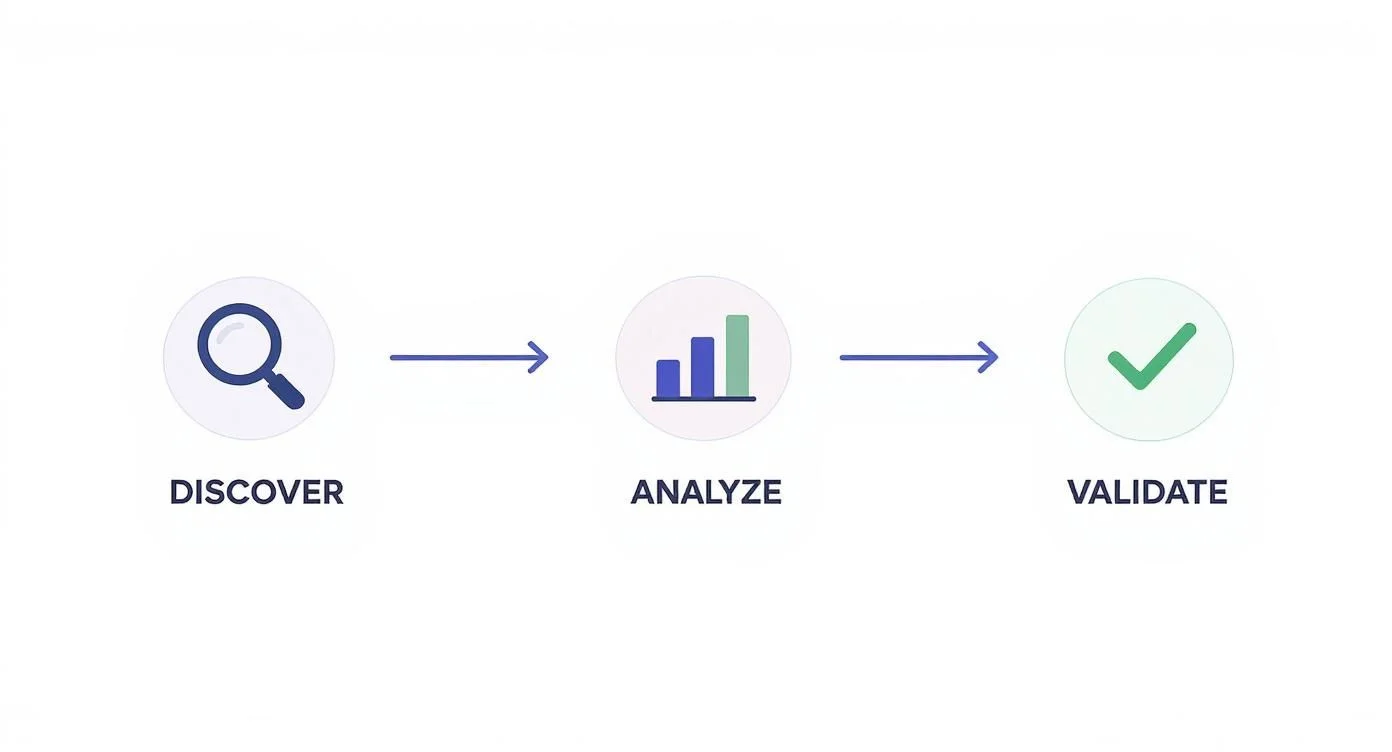
Finding winning products follows three stages: Discover (identify trending categories from social and search signals), Analyze (validate demand and competition with real data), and Validate (test with real buyers before committing inventory budget).
Profitable product research is a funnel: you start broad with many potential opportunities, narrow through data analysis, and confirm with real-world demand tests. Here is the three-stage framework:
| Stage | Activities | Tools |
|---|---|---|
| 1. Discover | Social trends, search trends, marketplace browsing | TikTok, Google Trends, Amazon Movers |
| 2. Analyze | Web scraping, keyword research, competitor study | Clura, Helium 10, Amazon BSR |
| 3. Validate | Landing pages, micro-ads, pre-orders | Shopify, Meta Ads, Typeform |
Most sellers skip stages two and three entirely, going straight from "I like this product" to placing inventory orders. The data shows that products with research backing have dramatically higher success rates. For a deeper look at the analytical tools in stage two, see our guide on Amazon product research tools.
Stage 1: Finding Market Signals
The best market signals come from three sources: social media engagement patterns (especially TikTok), Google Trends search volume growth, and competitor sales rank movements on Amazon and other marketplaces.
TikTok's #TikTokMadeMeBuyIt tag has generated billions of product discovery views. Products trending there often reach Amazon and Shopify searches within weeks. The pattern recognition skill to develop: look for products with high engagement (comments like 'where can I buy this?') but few established sellers.
Use Google Trends to confirm search volume is growing, not declining. A product with rising search volume over 12 months is a better bet than one with a single viral spike. Filter by country, time range, and related queries to understand the full demand picture.
For market sizing, focus your research on medium markets ($100M-$1B revenue range) where the 47% success rate for new entrants is highest. Niche markets under $100M show 52% success rates but have lower revenue ceilings. Hyper-competitive markets above $1B typically require significant capital to break through.
Put research on autopilot with Clura: set up daily scrapes of competitor product pages to track price changes, monitor new product launches, and aggregate customer reviews. What takes hours to do manually becomes a 5-minute morning briefing.
Stage 2: Automate Your Product Research
AI-powered web scraping lets you collect competitor pricing, review counts, bestseller ranks, and product titles from Amazon and other marketplaces automatically — turning hours of manual research into a minutes-long automated workflow.
Manual product research is slow, error-prone, and impossible to scale. An AI scraping workflow automates the data collection step so you can spend your time on analysis and decisions instead of copy-pasting spreadsheet rows.
Here is the Amazon product research workflow using Clura:
- Search Amazon for your target category and sort by Best Sellers or Most Wished For
- Launch Clura on the search results page
- Click on product title, price, rating, review count, and bestseller rank to define your data fields
- Clura automatically captures the same fields for every product on the page
- Export to CSV and repeat for pages 2-5 to build a comprehensive dataset
The key data points to capture in your product research database:
| Data Point | Why It Matters |
|---|---|
| Product Title | Keyword signals, positioning, naming conventions |
| Price | Market price range, margin calculation |
| Customer Rating | Quality bar and improvement opportunity |
| Number of Reviews | Market maturity and competition level |
| Bestseller Rank | Sales velocity proxy and category demand |
Stage 3: Validate Demand Before You Invest
Demand validation tests whether real buyers will pay for your product before you commit inventory budget — using landing page traffic, micro-ad campaigns, or pre-orders to generate actual purchase intent data.
Your data analysis in stage 2 narrows the field. Now validate the finalists with real buyer signals. Look for products that show: consistently high sales volume with manageable competition (under 500 reviews for top sellers), 4.5+ star ratings with specific, fixable complaints in reviews that you could address, and estimated margins of 30%+ after cost of goods, shipping, and advertising.
Real-world demand tests that work:
- Build a simple landing page describing the product and add a 'Notify Me When Available' email capture form
- Run a $50-100 Meta or TikTok ad campaign targeting your ideal customer and measure click-through and sign-up rates
- Launch a pre-order offer on Kickstarter or your Shopify store at a discounted early-bird price
- Post in relevant Reddit, Facebook Group, or Discord communities to gauge organic interest
Research Products Smarter With Real Competitor Data
Clura automatically tracks competitor pricing, reviews, and product changes so you always know what is selling and at what price. Start building your research database today.
Add to Chrome — Free →According to product launch research, products with pre-validated demand are 3x more likely to achieve their first-year revenue targets. The $50-100 you spend testing demand is the cheapest insurance you can buy against a $5,000 inventory mistake. See product launch statistics for more data on what separates successful launches from failures.
Sourcing and Scaling Your Winning Product
Once demand is validated, choose a sourcing model — dropshipping, wholesale, or private label — based on your capital, risk tolerance, and margin goals, then vet multiple suppliers before committing.
Three sourcing models to consider:
| Model | Capital Required | Margin | Risk | Best For |
|---|---|---|---|---|
| Dropshipping | Zero inventory | Thin (10-25%) | Low | Testing and first products |
| Wholesale | Medium (inventory) | Moderate (30-50%) | Medium | Proven categories |
| Private Label | High (MOQ + branding) | High (50-70%) | Higher | Building a brand |
Dropshipping is the lowest-risk entry point: you list products, take orders, and your supplier ships directly to customers. Margins are thin but inventory risk is zero — making it ideal for demand testing. Once a product proves itself, transitioning to wholesale or private label dramatically improves your margins.
Supplier vetting checklist:
- Contact 5-10 suppliers for every product you plan to source — competition keeps prices honest
- Verify credentials: business licenses, factory certifications, export history
- Always request product samples before placing any inventory order
- Negotiate payment terms: 30% deposit, 70% on shipment is standard
- Build redundancy — have at least one backup supplier qualified before you scale
Frequently Asked Questions
How much money do I need to start finding and selling winning products?
Product discovery is essentially free — Google Trends, TikTok research, and Amazon browsing cost nothing. Demand validation can be done for $50-100 in micro-ad spend. Initial inventory for dropshipping is zero. For wholesale or private label, budget $500-2,000 for your first product run including samples, sourcing, and initial ad testing.
What are the biggest mistakes people make in product research?
The two most costly mistakes are falling in love with a product idea and skipping validation (confirmation bias kills more businesses than bad products), and ignoring unit economics — entering a market without calculating whether your cost of goods, shipping, returns, and advertising costs leave a viable margin at competitive price points.
How do I spot an over-saturated product market?
Signs of over-saturation: top search results show thousands of reviews from established sellers (not just a few hundred), cost-per-click for product keywords is $2+ in Amazon or Meta ads, you are bombarded with ads for the product yourself, and margins have compressed to under 20% at competitive price points. These signals mean the market is mature — not impossible to enter, but requiring differentiation rather than commoditized competition.
Conclusion
Finding winning products is a skill built through repetition of the discovery-analyze-validate framework. The sellers who win consistently are not the ones with the best hunches — they are the ones who have built systems for collecting market signals, analyzing competitive data, and testing demand quickly and cheaply.
Automation is the force multiplier. Manual research limits you to a handful of products per week. AI-powered data collection lets you monitor hundreds of potential opportunities simultaneously, flagging the ones worth deeper investigation.
Start with one product category you know well, run one complete research cycle using the framework above, and let the data tell you what to sell. Then repeat.
Explore related guides:
- Amazon Product Research Tools — The best tools for finding and validating winning products on Amazon
Automate Your Product Research Today
Clura tracks competitor prices, monitors bestseller ranks, and aggregates customer reviews from Amazon and beyond — giving you the market data you need to find winning products faster.
Add to Chrome — Free →About the Author