
How to Find Niche Markets and Uncover Hidden Profits
Finding a profitable niche market is not about luck — it is a process of listening, validating, and connecting. Instead of chasing massive, saturated markets, the real opportunity lies in identifying underserved audiences with very specific problems. When you find a group with a shared passion or a nagging pain point that big companies are ignoring, you unlock higher engagement, less competition, and the ability to build a fiercely loyal community.
This guide gives you a practical, data-backed roadmap to find these hidden gems. If you want to understand how companies gather this kind of laser-focused market intelligence systematically, our guide on what is market intelligence is a great complement.
Collect Market Intelligence from Any Website in One Click
Clura’s AI browser agent lets you scrape Reddit threads, Amazon reviews, job boards, and competitor pages to gather the raw market data you need to validate niche ideas — no code required.
Add to Chrome — Free →Why Going Niche Is Your Ultimate Superpower
Focusing on a niche market concentrates your competitive power — instead of trying to appeal to everyone, you become the go-to authority for a specific, passionate audience willing to pay a premium for solutions that truly understand their needs.
Huge, generic markets are constantly splintering into thousands of micro-communities, each with its own language, inside jokes, and unique needs. Consumers are exhausted by one-size-fits-all products and actively seek out brands that “get” them. When you focus on a niche, you can speak your audience’s language, charge a premium for solving specific problems, and stop wasting marketing dollars trying to reach everyone.

- Create real connections: speak your audience’s language and become a trusted voice in their world
- Charge what you’re worth: specific, urgent problems command premium prices
- Stop wasting marketing dollars: pinpoint your exact customer with laser-focused campaigns
Where to Hunt for Untapped Niche Ideas
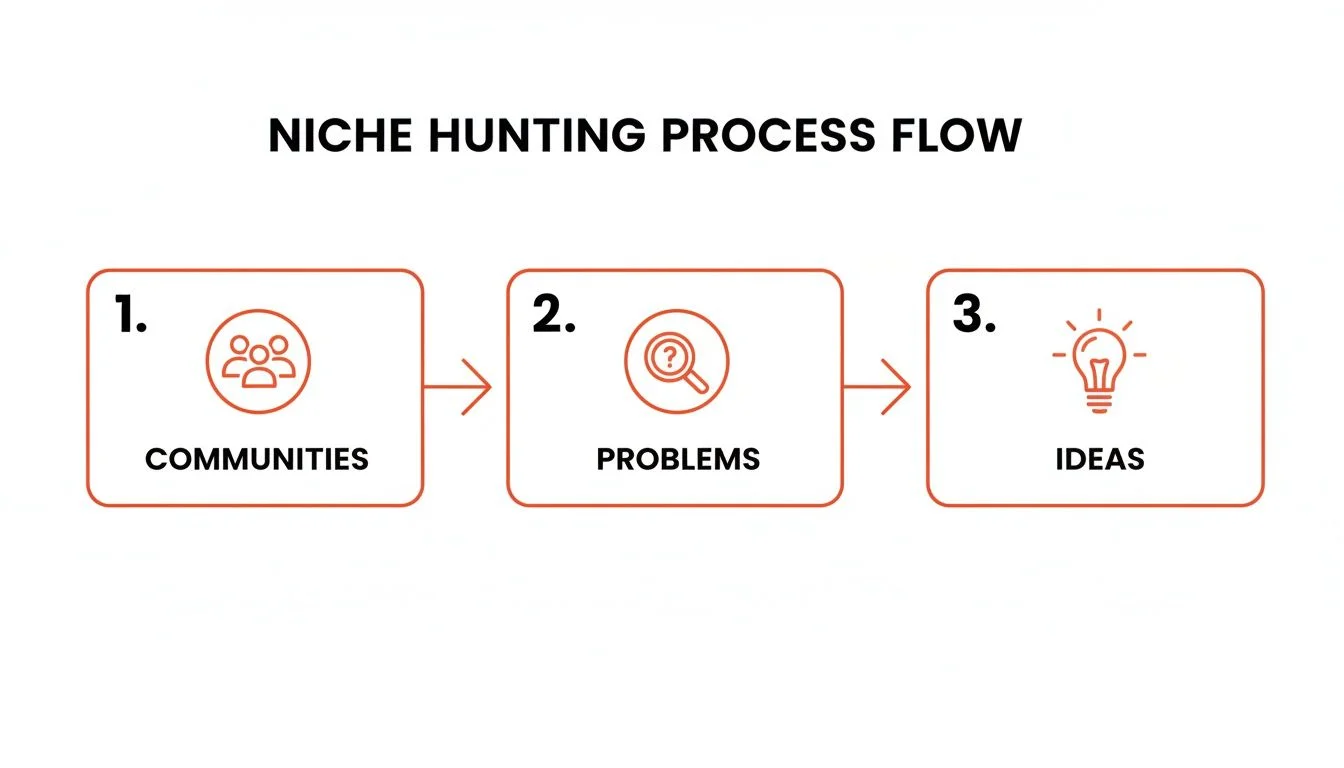
The most profitable niche ideas are hidden inside passionate online communities — Reddit subreddits, specialized forums, Product Hunt, Kickstarter, and B2B job boards — where real people describe their unsolved problems in plain language.
1. Dive into Niche Subreddits
Reddit is a goldmine for unfiltered consumer insights. Thousands of hyper-focused subreddits cover every hobby, profession, and interest imaginable — and people go there to complain, ask for advice, and geek out about their passions. Look for patterns: repeated pain points in a woodworking subreddit, a vegan skincare group lamenting a lack of affordable cruelty-free retinol, or specialized tools that pros keep wishing existed. These are giant, flashing signs pointing to market gaps.
2. Monitor Specialized Online Forums and Groups
Beyond Reddit, countless independent forums and Facebook Groups serve hyper-specific communities. Jump into groups aligned with your interests and listen for phrases like “Does anyone know how to...”, “I’m looking for a tool that can...”, or “My biggest frustration with X is...”. Every one of these is a breadcrumb leading straight to a niche idea.
3. Analyze Product Hunt and Kickstarter for What’s Next
Platforms like Product Hunt and Kickstarter are excellent for spotting emerging trends. The pro move: dig into the comments on projects that did NOT get funded. Sometimes the core idea was brilliant but the execution was off — an open door for you to do it better. Look for projects with passionate communities buzzing around them and pay attention to what features backers are begging for.
4. Scrape B2B Job Boards for Service Gaps
Companies practically scream their biggest operational pain points when they are trying to hire. A spike in job postings for “Salesforce integration specialists” or “HubSpot automation experts” signals strong, growing demand. This could be your chance to launch a niche consulting agency, create a high-demand course, or build a software tool that makes those tasks easy. There are fantastic market research tools for startups that can automate this data collection.
Using Data to Find the Gold
Validating a niche idea requires analyzing three data signals: audience demand (keyword search volume and forum activity), competitive landscape (number and size of incumbents), and monetization potential (commercial intent and existing paid solutions).
Gauging Demand with Search and Social Data
Start with keyword research tools. Hunt for keywords with healthy search volume that are not dominated by huge brands. Focus on long-tail keywords — specific phrases showing high purchase intent. A niche with 1,000 monthly searches for a specific, high-intent keyword can be far more valuable than a generic term with 100,000 searches. It is all about finding a hungry, targeted audience, not just a big one.
Analyzing the Competitive Landscape
A few competitors is actually a good sign — it proves people are spending money in this space. Your goal is not to find an empty field but to find one where you can carve out territory. Identify the top players (are they huge corporations or small independents?), find their weaknesses (dive into customer reviews for recurring complaints), and analyze their marketing for gaps you can fill. A faster approach is using an AI-powered tool to scrape data from Amazon search results or software directories like G2 to gauge saturation instantly. For a deeper look, check out our guide on how to do market research for small business.
Niche Opportunity Scoring Matrix
| Niche Idea | Audience Signal | Competition Level | Monetization Potential | Score |
|---|---|---|---|---|
| Sustainable Pet Toys | 15k/mo searches | 5 major, 20 small | High | 8/10 |
| AI Tools for Solo Lawyers | 5k/mo searches | 2 major, 5 small | High | 9/10 |
| Keto Meal Prep Delivery | 50k/mo searches | 10 major, 100+ small | Medium | 6/10 |
Don’t Build a Thing Until You’ve Done This
Validating a niche idea before investing in development requires running small, cheap experiments — a simple landing page to test messaging, micro-ads to drive targeted traffic, and ultimately a smoke test to measure real buying intent.
Your First Litmus Test: The Simple Landing Page
Build a dead-simple one-page website to sell the concept and see who bites. Keep it brutally focused: a killer headline naming the problem and target customer, a punchy value proposition, a great visual (even a mockup works), and one clear call to action like “Be the first to know when we launch.” Every email signup is a real person raising their hand saying “yes, you found a problem I have.”
Pour a Little Gas on the Fire with Micro-Ads
Send traffic to your landing page with a small, laser-focused ad campaign on Facebook, Instagram, or a niche subreddit. You do not need a massive budget — $50 to $100 is often enough to see if you have a winner. Target people based on the audience insights you gathered. Watch click-through rate, cost per click, and landing page conversion rate. For a pre-launch page, anything around 5% conversion or higher is a fantastic sign.
The Ultimate Tell: The Smoke Test
The smoke test is the final boss of pre-product validation: set up a realistic-looking pre-order page for a product that does not exist yet, complete with pricing and features. When a user clicks “Pre-Order Now,” they land on a page explaining the product is coming soon with an offer to join the early-bird list. This directly measures buying intent — not just interest but willingness to pull out a credit card.
Gather Market Research Data Before You Build
Use Clura to scrape competitor reviews, Reddit discussions, and job board data to validate your niche idea with real market signals — all without writing a single line of code.
Add to Chrome — Free →Connecting With the Modern Niche Consumer
Connecting with niche consumers requires becoming a genuine part of their community — learning their language, understanding their values around authenticity and sustainability, and engaging without a sales pitch before you ever try to sell.

A niche is not just a product category — it is a culture. Modern consumers, especially passionate niche community members, can spot a phony a mile away. They are not just buying a thing; they are buying into an identity, a shared set of values, and a story they want to be part of.
- Become an influencer detective: study what content the big names in your niche create and what posts blow up
- Mine customer reviews for gold: ignore star ratings and look for the emotional language in competitor reviews
- Get in the trenches: participate in conversations, ask smart questions, and offer advice without a sales pitch
Frequently Asked Questions
Is this niche too small to actually make money?
Profitability is driven by spending power and problem urgency, not just audience size. A small, fired-up audience with a burning problem is worth its weight in gold. Look for commercial signals: are people already buying imperfect solutions? Do they spend money on related passions? Does your idea save them significant time or money? A business with 1,000 true fans who buy everything you launch beats a million indifferent browsers.
Am I chasing a passing fad or a sustainable niche?
Check Google Trends data over the last five years. A sustainable niche shows either stable consistent interest or a gradual steady climb. A trend looks like a rocket launch followed by a crash. Also consider the why behind the interest — is it tied to a permanent lifestyle choice or a core identity, or is it driven by a passing novelty?
Can AI tools help find niche markets?
Absolutely. AI tools are exceptional research assistants for niche discovery. They excel at lightning-fast data collection and spotting patterns a human might miss. An AI-powered scraper can collect and structure conversations from hundreds of forums or thousands of product reviews in minutes. The final strategic call remains yours — human intuition for emotional context behind the data is still essential.
How do I use data to validate a niche idea before building?
Use a three-step framework: first gauge demand with keyword research tools looking for specific high-intent queries with meaningful volume. Second, analyze competition by scraping marketplace and directory data to assess saturation. Third, confirm monetization potential by checking for existing paid solutions, affiliate blogs, and sponsored content proving people already spend money in this space.
Conclusion
Finding a profitable niche market is a repeatable process, not a lucky strike. Start by observing passionate online communities on Reddit, forums, and job boards to identify unsolved problems that real people describe in plain language.
Use data to analyze demand, competition, and commercial potential before investing time or money in building. Then validate your best ideas with simple landing pages and micro-ad campaigns that test real buying intent — not just opinions from friends.
The final ingredient is authentic connection. By becoming a true member of the community, learning their language, and engaging genuinely before you ever pitch, you build the kind of loyal audience that sustains a thriving long-term business.
Explore related guides:
- What Is Market Intelligence —
- Market Research Tools for Startups —
- How to Do Market Research for Small Business —
Start Your Niche Research with Real Market Data
Clura lets you scrape Reddit threads, competitor reviews, and job boards to collect the raw signals you need to validate a niche before you build. Get started free today.
Add to Chrome — Free →