
How to Find Dropshipping Products That Actually Sell in 2026
Clura Team
Finding winning dropshipping products should never be a guessing game. The global dropshipping market is expected to grow from $330.86 billion in 2025 to $401.41 billion in 2026 — a 21.3% growth rate — creating enormous opportunities for sellers who use data to spot trends before competitors do.
This guide shows you how to validate products with real demand, reverse-engineer what competitors are already selling, and build a repeatable research system that consistently surfaces profitable items. Forget wasting time and money on duds — let's build a data-backed product discovery engine.
Extract Competitor Product Data in One Click
Clura's Chrome extension lets you instantly pull entire product catalogs from competitor Shopify stores and Amazon listings — with prices, reviews, and bestseller rankings organized in seconds.
Add to Chrome — Free →Your Blueprint for Finding Winning Products
The blueprint for finding winning dropshipping products combines reading market trends, reverse-engineering what is already selling, and validating social proof — all using real-time data rather than gut feelings.
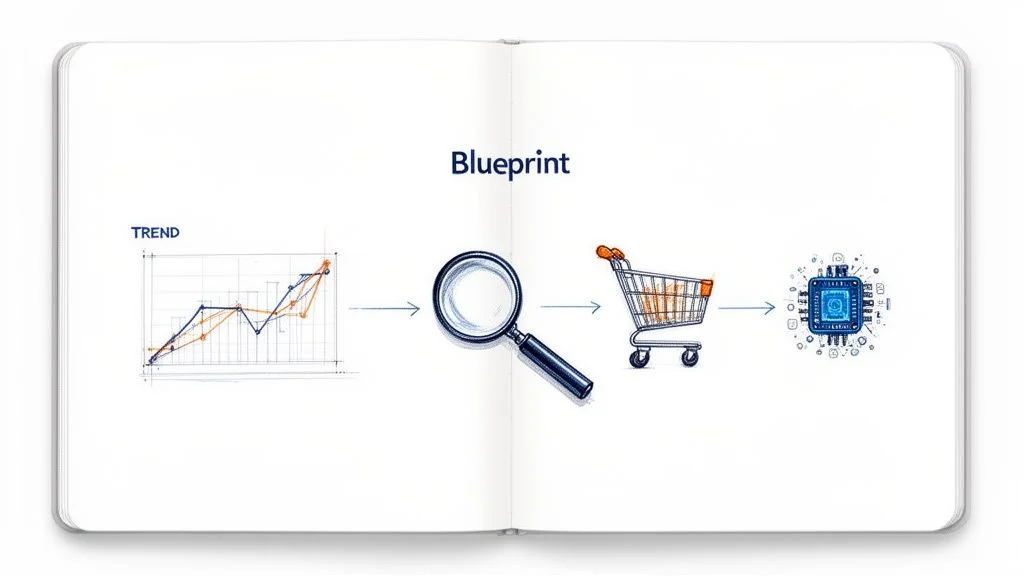
Instead of relying on hunches, top sellers extract real-time data from platforms like Shopify, Amazon, and social media to see what customers are already adding to their carts. The core principles are simple: use data over intuition, study competitor success as a shortcut, and never commit to a product until profit margins are confirmed.
- Data Over Hunches: look at what is selling right now, not what you think might sell.
- Ethical Spying: study competitor successes to find shortcuts and avoid costly mistakes.
- Profit-Focused Validation: a product in high demand is useless if it cannot generate a healthy margin after all costs.
Pinpoint Your Niche and Uncover Market Gaps
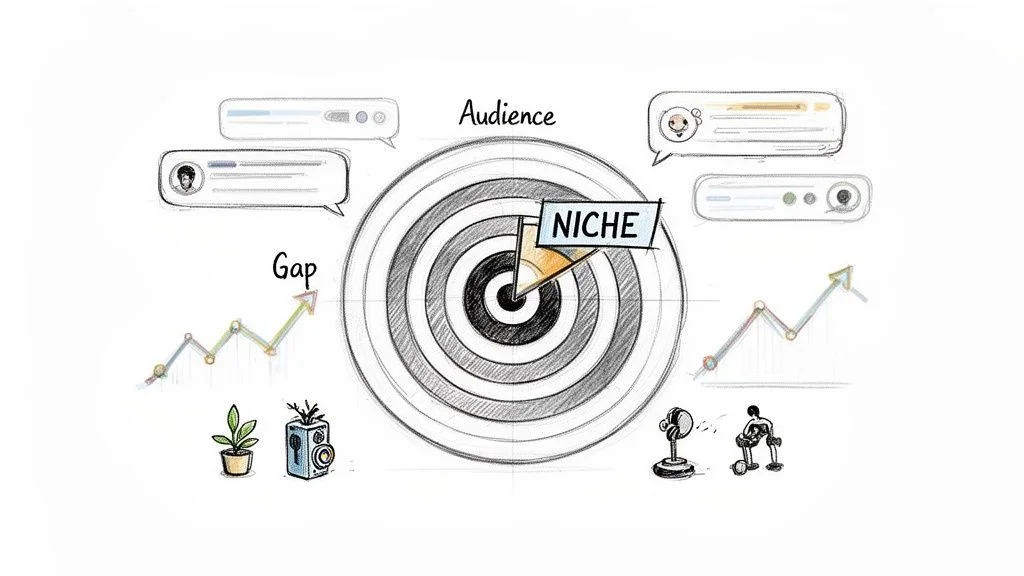
Finding a profitable dropshipping niche means identifying a specific audience where buyer demand outpaces the number of sellers — ideally a niche within a niche that sidesteps brutal competition from mass-market sellers.
Brainstorm Ideas That Actually Connect
The best product ideas often come from your own passions, professional expertise, or problems you have faced. A camper who knows that most tent stakes are flimsy sees an opportunity. A graphic designer knows exactly what is missing in the ergonomic mouse market. Personal experience is a goldmine because you understand what customers want and what they are tired of.
Gauge Market Excitement with Free Tools
Your first stop should be Google Trends. Enter your product ideas and check search interest over the last few years. You are looking for a steady upward trend or reliable seasonal peaks, which signal healthy demand. Next, dive into Reddit communities: r/Homebrewing has over 1.1 million members, r/SkincareAddiction has 1.9 million, and r/MechanicalKeyboards has 1.3 million enthusiasts. Their complaints about existing products are pure gold for product ideas.
Evaluate Long-Term Potential
- Can you build a brand around this niche? Hobbies and lifestyles are perfect because people want community.
- Are there accessory opportunities? Selling espresso machines opens doors to beans, tampers, and cleaning kits.
- Is it a fad or a trend? Fads burn out fast while trends have longevity — Google Trends helps tell the difference.
Use Competitor Data to Find Proven Winners
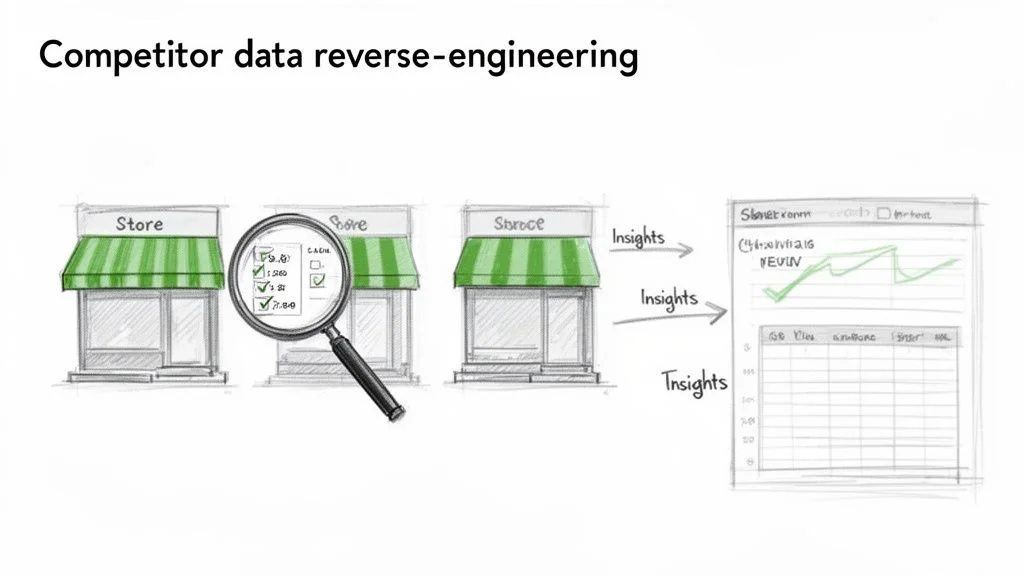
Using competitor data to find dropshipping products means reverse-engineering successful stores to see what is already selling — treating their bestseller lists and sales data as a cheat sheet for your own product selection.
Step 1: Find and Analyze Top Competitors
Focus on other successful dropshippers in your niche, not massive corporations. Find them through social media ads (consistent TikTok and Facebook ads signal a profitable product), Best Of blogs, and marketplace directories. Once you have a shortlist of 3–5 competitors, check their Bestsellers or Most Popular sections.
Step 2: Let an AI Scraper Do the Work
With an AI-powered browser scraper like Clura, you can visit a competitor's Shopify store and instantly extract their entire product catalog — thousands of products with prices, descriptions, and rankings organized in a spreadsheet in seconds. This gives you a complete blueprint of their operation.
Step 3: Decode Their Winning Strategy
- Solves a Real Problem: do their top sellers make life easier or fix a nagging issue?
- High Perceived Value: do the products look more expensive than they cost to source?
- A Wow Factor: is it unique, visually striking, or great for a social media demo?
- Creates More Opportunities: do their bestsellers lead to follow-up purchases of accessories or refills?
Pull Competitor Catalogs Instantly with Clura
Extract thousands of products from any Shopify or Amazon store with a single click — prices, ratings, and bestseller data organized in a spreadsheet ready for analysis.
Add to Chrome — Free →Spot Viral Products on Social Media and Discovery Sites
Spotting viral dropshipping products on social media means systematically searching trending hashtags, following niche influencers, and combining social hype data with supplier order volume to validate demand before investing.
The hashtag #TikTokMadeMeBuyIt has billions of views. Your job is to dive into that content and find the patterns. Search for terms in your niche like kitchen hacks, dorm room essentials, or skincare routine. Follow niche influencers, analyze viral audio clips, and read comments — the comment section is a goldmine of unfiltered buying intent.
Master Product Discovery Platforms
Platforms like AliExpress and CJdropshipping show you what is actually selling. Use their filters to find products with thousands of orders (clear sign of steady demand), ratings of 4.8 stars or higher, and suppliers with a track record of at least a few years and a rating above 95%.
Combine Social Listening with Sales Data
The winning strategy is to connect social hype with hard supplier sales data. Google Trends might show a 500% search spike for a viral product. Confirm it has thousands of AliExpress orders, then read reviews to ensure quality. By combining these two research methods, you create a powerful validation loop that removes the guesswork.
Validate Product Demand and Calculate Your Profits
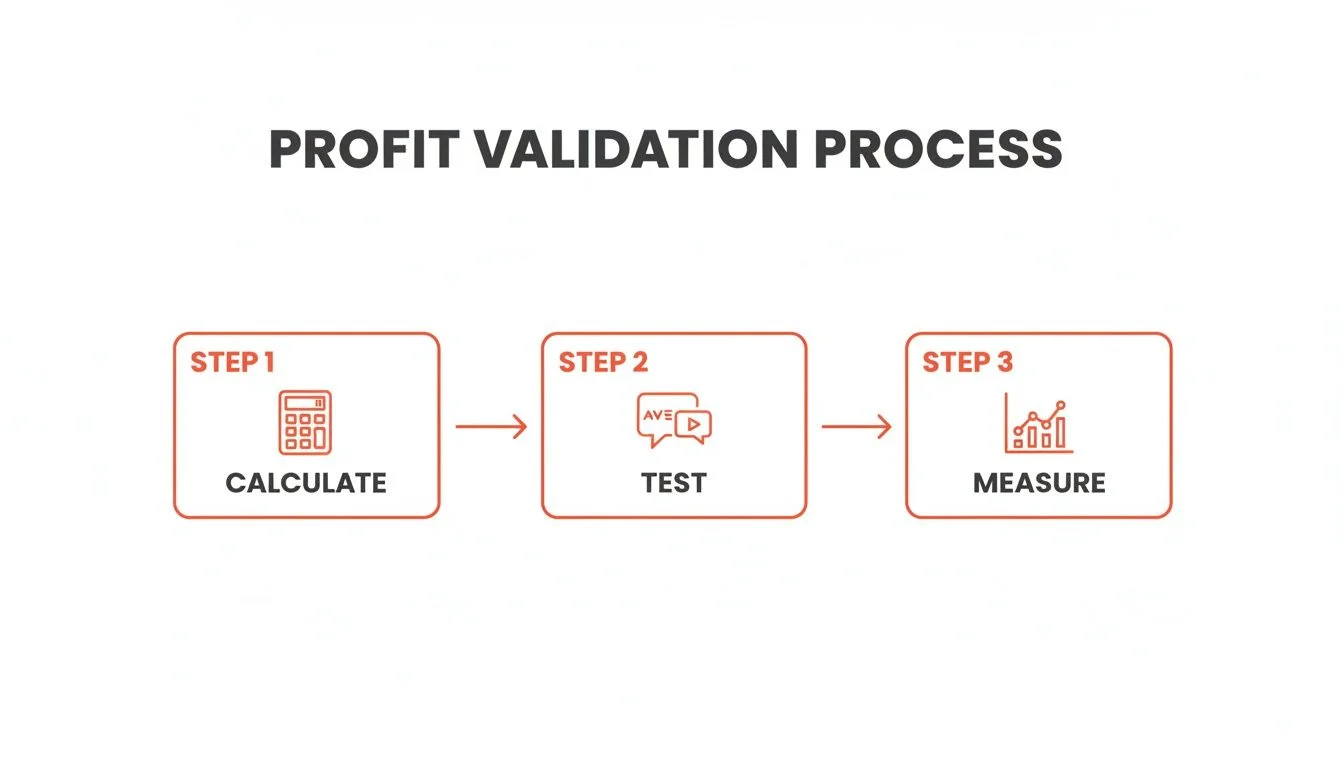
Validating dropshipping product demand means running the profit margin math before committing, then testing with a $100–$200 ad budget to confirm real buyer intent through click-through rates, add-to-carts, and cost per acquisition.
Step 1: Calculate Your Potential Profit Margin
A healthy dropshipping business aims for a 20–30% profit margin. Calculate your landed product cost (item plus shipping), add transaction fees (around 2.9% + $0.30 per sale), and factor in your customer acquisition cost from ads. For example: source for $15, sell for $40, after a $1.46 transaction fee and $10 ad spend, your net profit is $13.54 — a 33.8% margin.
Step 2: Test with a Small Ad Budget
Set aside $100–$200 and run a targeted campaign on TikTok or Facebook. The goal is to gather data: are people actually interested in buying? Watch your click-through rate, add-to-cart rate, and cost per acquisition closely.
Step 3: Measure the Right Metrics
- Click-Through Rate (CTR): high CTR means your ad and product are grabbing attention.
- Cost Per Click (CPC): shows how competitive the ad space is for your niche.
- Add to Carts (ATC): a strong sign of buying intent from people who clicked.
- Cost Per Acquisition (CPA): if your CPA is lower than your profit per sale, you have a winner.
Build Your Repeatable Product Research System
A repeatable dropshipping product research system is a four-step workflow — Ideate, Research, Validate, Test — that removes guesswork and provides a steady stream of data-backed product candidates to evaluate consistently.
Finding one winning product is great, but a repeatable system is what builds a lasting business. With a proven process you can move with confidence, make data-driven decisions, and consistently stock your store with products people want to buy.
- Ideate: scroll TikTok and Reddit to spot what people are passionate about or complaining about.
- Research: check Google Trends for search volume and use AI scraping tools to confirm similar products are bestsellers on Shopify or Amazon stores.
- Validate: head to supplier platforms to calculate your landed cost and potential profit margin before getting attached to a product.
- Test: run small targeted ad campaigns on Facebook or TikTok with a minimal budget to gather real click-through and acquisition cost data.
A tool like Clura is the engine of this research system — in a single click it extracts thousands of data points from competitor stores, saving hours and giving you a clear picture of what is working right now. This ends the stressful search for the next big thing and replaces it with a predictable, data-driven process.
Frequently Asked Questions
What kinds of dropshipping products should I avoid?
Avoid trademarked or copyrighted goods (legal liability), fragile or oversized items (high shipping costs destroy margins), and complex electronics (high defect rates and support burden). Focus on simple products that solve a real problem, have a wow factor, and are small and lightweight.
How much money do I need to test a dropshipping product?
You can get a solid initial read on a product with just $100 to $300. Use that budget to run targeted ads for a few days on TikTok or Facebook. The goal is to gather data — clicks, high engagement, and add-to-cart actions — to decide whether to invest more before committing fully.
How can I find trustworthy dropshipping suppliers?
Look for suppliers on AliExpress or CJdropshipping with a seller rating above 95%, a track record of at least a few years, and a high number of orders. Read recent reviews carefully for quality and shipping time feedback. Always order a sample yourself before selling to your customers.
How do I use AI scraping tools for dropshipping product research?
AI browser extensions like Clura let you visit a competitor's Shopify store or Amazon search results and extract the entire product catalog — names, prices, ratings, and review counts — with a single click. This gives you a blueprint of what is selling and at what price points, allowing you to analyze multiple competitors quickly.
What is a healthy profit margin for dropshipping?
A healthy dropshipping business aims for 20–30% net profit margin after accounting for product cost, shipping, transaction fees (around 2.9% + $0.30 per sale), and customer acquisition cost from ads. Always run the complete math before committing to a product to avoid selling at a loss.
Conclusion
The dropshipping market hit $286.4 billion in 2023 and continues growing rapidly because top sellers use data to their advantage. By combining competitor catalog analysis, social trend spotting, supplier validation, and small-budget testing, you build a system that consistently surfaces winning products.
Start today by picking one competitor in your niche and extracting their bestseller data. Run the profit math on their top 10 products. You will quickly see which items have the right margins, demand signals, and supplier quality to build a real business around.
Explore related guides:
- Amazon Product Research Tools — automate product research and competitive analysis on Amazon
- How to Find Dropshipping Suppliers — step-by-step guide to vetting and connecting with reliable suppliers
- Social Media Scraping Tools — automate trend spotting and sentiment research across social platforms
Stop Guessing — Start Researching with Real Data
Clura pulls product data from any Shopify store, Amazon listing, or supplier platform in one click. See what competitors are selling and pinpoint profitable products in a fraction of the time.
Add to Chrome — Free →About the Author