A Practical Guide to Ecommerce Product Catalog Management

A Practical Guide to Ecommerce Product Catalog Management

Master ecommerce product catalog management with this ultimate 2026 guide. Learn to optimize, automate, and scale your product data for explosive growth.

Let's be honest, ecommerce product catalog management sounds a bit dry. But here’s the secret: it’s the most important system you have for organizing and publishing your product information across all sales channels.

Think of it as the strategic heart of your online business. It's the process that turns a chaotic mess of supplier data into a clean, trustworthy foundation that powers your entire customer experience. Without it, you’re not running an online store—you're just managing a very messy digital stockroom. This guide will show you how to do it right.

Why Is Product Catalog Management So Important?

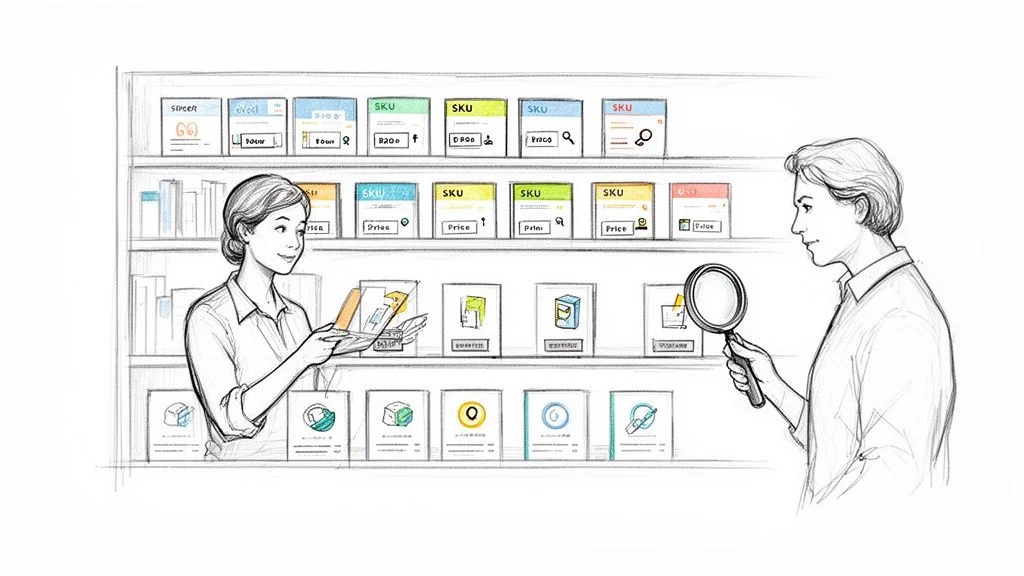
Two people managing an e-commerce product catalog, one inspecting items and the other holding a magnifying glass.

Imagine your online store is a massive library. Your products are the books, and customers are wandering the aisles, excited to find their next purchase. Your product catalog management is the expert head librarian—the one who knows exactly where everything is.

This system ensures that when a customer searches for "science fiction," they don't accidentally get a cookbook. It makes browsing a joy and finding a specific item effortless. Now, picture that same library without the librarian. Books are piled everywhere, and there’s no clear path to discovery. That's what an online store feels like when catalog management is an afterthought.

The Strategic Core of Modern Commerce

Great catalog management is much more than data entry; it’s the engine that drives your ecommerce operation. It directly impacts everything from customer happiness to your bottom line. When your product information is accurate, consistent, and rich with detail, you create a shopping journey that just works.

This solid foundation of trust sends positive ripples throughout your business:

  • Boosted Sales and Conversions: It’s simple. Shoppers who can easily find what they’re looking for are more likely to buy. Clear product titles, accurate specs, and helpful filters remove friction from the path to purchase.

  • Improved SEO Performance: Search engines like Google love structured, high-quality data. A well-managed catalog with consistent attributes and keywords helps your product pages climb search rankings, bringing in valuable organic traffic.

  • Reduced Product Returns: A top reason for returns is a gap between what a customer expects and what they get. Detailed, accurate descriptions and great images ensure customers know exactly what they're buying, which can slash your return rates.

  • Enhanced Customer Trust: A professional, error-free catalog signals that your brand is credible. Typos, missing information, and broken images destroy that confidence in an instant.

Your product catalog is your digital storefront. Every piece of data—from the SKU to the marketing copy—is an opportunity to either win or lose a customer.

Scaling Without the Chaos

As your business grows, so does the complexity. You might source products from dozens of suppliers, each with its own data format. One supplier might list a color as "BLK," another might use "Black," and a third could forget the attribute entirely. This is where the chaos begins.

Effective ecommerce product catalog management solves this. It gives you a central hub to ingest, clean, and standardize all this messy data before it reaches your customers.

This growing need for a single source of truth is why the global market for these systems is exploding. Market analysis projects the Catalog Management System Market will skyrocket to USD 3.73 billion by 2031, driven by the need for unified data to power things like personalization. You can explore more data on the industry's growth to see how enterprises are leading this charge.

Ultimately, this process transforms what could be an operational nightmare into a powerful competitive advantage.

Building Your Catalog With Strong Data and Taxonomy

Want to build an ecommerce catalog that customers love and search engines can’t get enough of? It all comes down to getting the foundation right. To nail this, you have to master two concepts: the data model and the taxonomy.

Think of your data model as the master blueprint for every product you carry. It’s the definitive guide to all the possible pieces of information—or attributes—you can have for an item. This goes beyond just a name and a price; it covers everything from technical specs to marketing details.

The Blueprint: Your Data Model

Your data model is a complete checklist of every attribute that could possibly describe a product. For something as simple as a t-shirt, this might include:

  • Core Identifiers: SKU, Product Title, Brand

  • Descriptive Attributes: Color, Size, Material (e.g., 100% Cotton), Sleeve Length

  • Media Assets: Product Images, Lifestyle Photos, Videos

  • Pricing and Inventory: Price, Sale Price, Stock Quantity

  • Logistics: Weight, Dimensions, Shipping Class

By defining this blueprint upfront, you create a universal standard for every product you add. It's the secret to preventing data chaos and makes your entire management process smoother.

The Aisle Signs: Your Taxonomy

If the data model is the blueprint, then your taxonomy is the set of friendly aisle signs for your digital store. It’s the hierarchical system you use to categorize and sort all your products so that customers can find their way around intuitively.

A brilliant taxonomy makes browsing feel natural. It guides shoppers from broad categories to more specific ones until they land on exactly what they were looking for.

A great taxonomy doesn’t just organize products—it mirrors how your customers think and shop. It anticipates their journey and leads them directly to the perfect item.

For example, a customer looking for running shoes should have a clear path:

Men's → Shoes → Athletic Shoes → Running Shoes

This logical structure is the magic behind powerful on-site search and a fantastic user experience. To get this right, incorporate effective category management best practices from the start.

Without a smart taxonomy, your store is a jumbled mess. A study found that 12% of top ecommerce sites still have major issues with their category navigation, showing how easy it is to get this wrong.

The 4 Pillars of a Winning Catalog Workflow

Wrangling product data can feel like herding cats. The secret is to think of it like an assembly line for your product information. You bring in raw materials, move them through key stages, and out comes a perfect, sellable product.

This workflow is built on four essential pillars that turn messy data into your most powerful sales asset. Getting this right is what separates the pros from the amateurs in ecommerce product catalog management.

1. Ingestion: Gathering Your Raw Materials

First, you have to get all your product information in one place. This is the Ingestion stage. Data will show up in all sorts of formats, often messy and inconsistent.

Your job here is just to gather it all. The cleanup comes later. Common sources include:

  • Supplier Data Feeds: CSVs and Excel files, or direct feeds from manufacturers.

  • Legacy Systems: Pulling whatever you can from your existing ERP or internal databases.

  • Manual Data Entry: Good old-fashioned data entry from your merchandising team.

  • Web Scraping: Using AI tools to automatically grab product specs, images, or pricing from other sites to fill in the blanks.

At this point, the goal isn't quality; it's quantity. Just get all the pieces onto the factory floor.

2. Normalization: Standardizing the Parts

Now it's time for Normalization. This is where you make sure all the parts fit together perfectly. You’re taking the messy, inconsistent data you just collected and whipping it into shape.

Imagine one supplier sends "BLK," another uses "Blk," and your team enters "Black" for a color. Normalization is the critical process of turning all of those into one standard value: "Black". This is what makes your website's filters and search actually work.

Normalization is the unsung hero of catalog management. It’s the meticulous, behind-the-scenes work that makes your data clean, trustworthy, and ready for a fantastic customer experience.

During this stage, your team will focus on tasks like:

  • Fixing typos and misspellings.

  • Standardizing units of measure (e.g., converting "inches" and "in." into a single format).

  • Ensuring dates and numbers all look the same.

  • Mapping supplier categories to your own master taxonomy.

This step is your defense against the "garbage in, garbage out" dilemma.

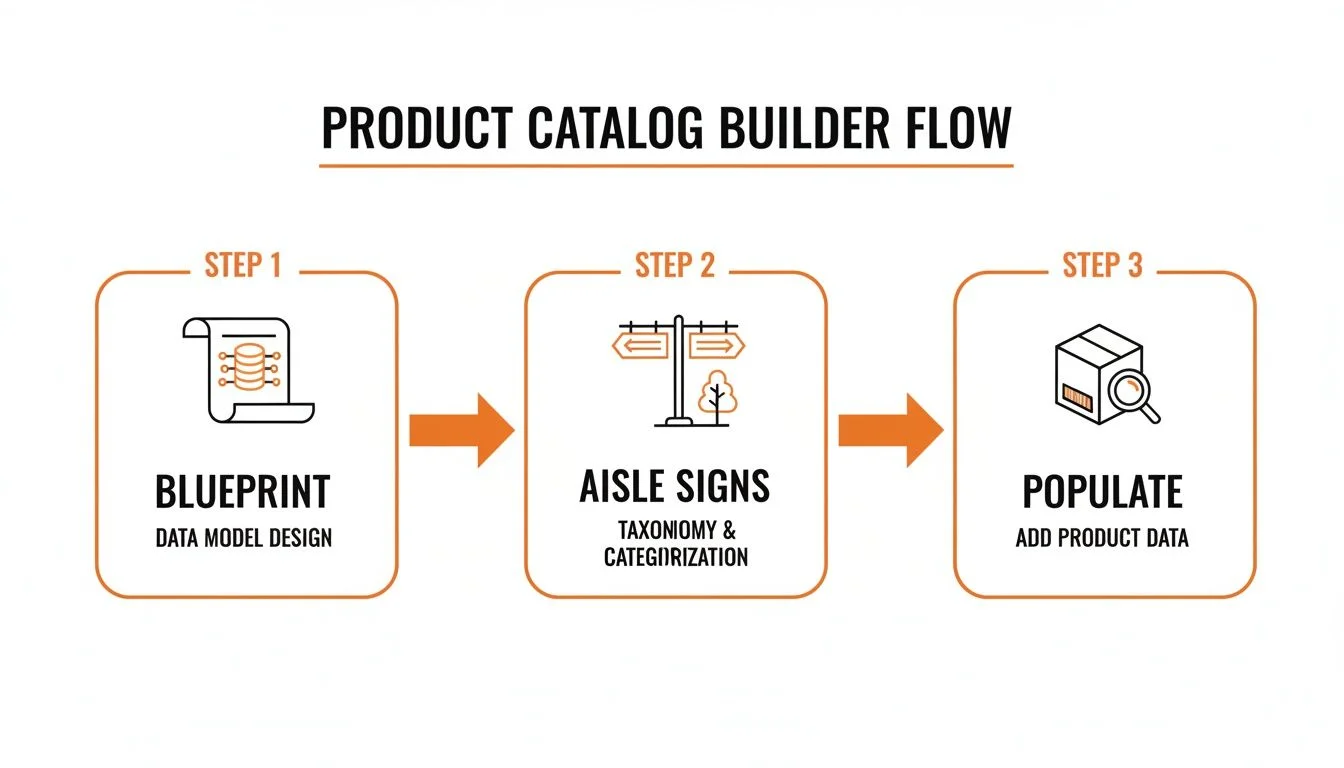
This flow chart gives a great visual of how you can turn a basic idea into a fully fleshed-out catalog.

Flowchart illustrating the three-step product catalog builder process: Blueprint, Aisle Signs, and Populate.

As you can see, starting with a solid blueprint (your data model) and clear aisle signs (your taxonomy) makes the whole process smoother.

3. Enrichment: Adding Value and Detail

With clean, standardized data, you're ready for Enrichment. This is where you add the sparkle that transforms a boring spec sheet into a product people want to buy. You're adding the rich, persuasive content that helps customers feel confident.

Enrichment is all about adding the good stuff:

  • Writing killer, SEO-friendly product descriptions that tell a story.

  • Uploading gorgeous, high-resolution images and product videos.

  • Adding customer reviews and other user-generated content.

  • Attaching technical specs, user guides, and other helpful docs.

  • Pulling in competitor pricing data to sharpen your strategy. We break down how to do this in our guide on how to automate online price tracking.

This is your chance to make products stand out, connect with shoppers, and give them every reason to click "add to cart."

4. Publishing: Shipping the Finished Product

Finally, we've reached the end of the line. Publishing is where you ship your perfected product data out to all your sales channels.

A great catalog management setup lets you push your data out seamlessly to all the places you sell:

  • Your main ecommerce site (Shopify or BigCommerce).

  • Online marketplaces like Amazon, eBay, and Walmart.

  • Social commerce channels like Instagram and Facebook Shops.

  • Your mobile app and even print catalogs for a true omnichannel experience.

The goal is to ensure a customer sees the same high-quality, accurate information about a product, no matter where they find you.

How Flawless Product Data Creates Ecommerce Winners

Alright, let's get to the good stuff—how all this catalog work actually makes you money. Perfect product data isn’t a boring chore; it's a huge competitive advantage. Think of it as your best salesperson, working 24/7 to win over customers.

When your data is clean, accurate, and complete, the results are immediate and powerful. You get happier customers, more sales, and a much smoother operation.

Slash Costly Returns and Build Unbreakable Trust

What’s the number one reason customers return products? Simple: the item wasn't what they expected. Fuzzy photos, missing dimensions, or wrong descriptions lead to disappointment and costly returns.

Great product data is your first line of defense. When you give shoppers crystal-clear, accurate information, they know exactly what they're getting. This not only crushes your return rate but also builds the deep customer trust that leads to loyalty.

Skyrocket Your Conversion Rates

Great data doesn't just prevent returns; it actively fuels sales. When a shopper can easily find what they're looking for and feel 100% confident in their choice, the "Add to Cart" button is an easy click. Every bit of clean data erases a reason for them to hesitate.

Ultimately, the goal is to optimize your product pages and improve ecommerce conversion rates. When you nail the data foundation and combine it with killer copy and images, as we discuss in our guide on Amazon product listing optimization, you've built a serious engine for growth.

Your customer experience is only as good as your product data. Messy data means failed searches, useless AI recommendations, and invisibility on tomorrow's shopping channels.

The New Currency of Commerce: Speed and Accuracy

In a market that changes by the minute, you have to be fast. Product data accuracy separates the winners from everyone else. It's shocking, but only 5% of e-commerce brands can update their digital storefronts in minutes. Most are stuck waiting for hours, a delay that kills marketing agility. As you can read more about how data quality shapes the future of retail, you'll see that bad data can sabotage everything from your site's search bar to its AI-powered suggestions.

This is why investing in proper ecommerce product catalog management delivers such a massive return. It turns your data from a slow liability into a fast, strategic weapon.

Automating Your Catalog With AI-Powered Tools

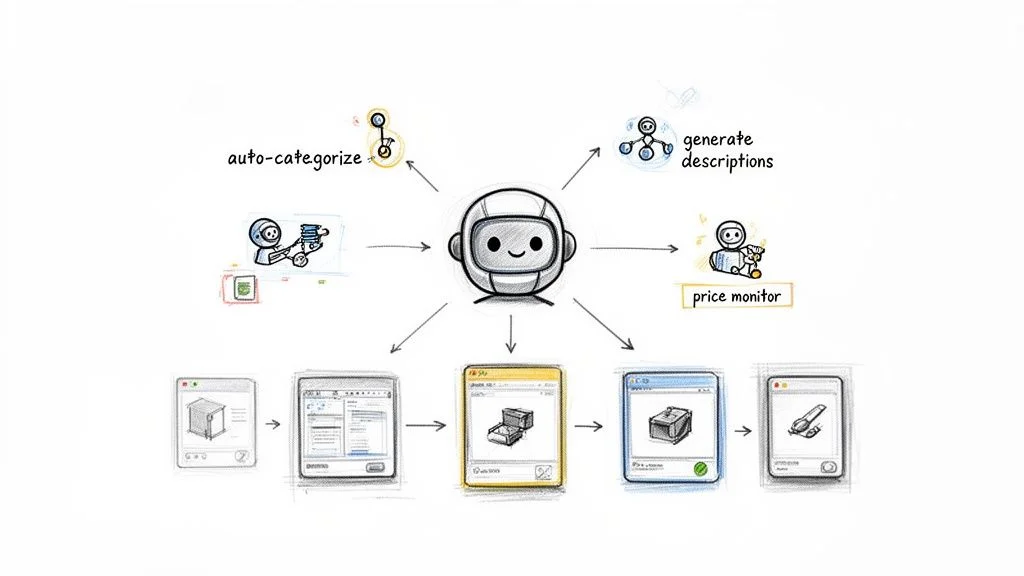
AI robot streamlining product catalog management with auto-categorization, description generation, and price monitoring.

Managing a growing product catalog by hand is like trying to fill a swimming pool with a teaspoon. It's slow, agonizing, and a terrible use of your team's talent. The exciting part? You can ditch the spoon and turn on the firehose by bringing automation into your ecommerce product catalog management workflow.

Modern AI-powered tools completely change the game, turning tedious, repetitive jobs into automated processes that just happen. Your team can finally get back to the strategic work that actually drives growth.

Where Automation Makes the Biggest Impact

AI isn't a far-off concept. It's a practical tool you can use right now to solve frustrating ecommerce problems. Think of it as hiring a super-smart digital assistant who works 24/7, never gets tired, and never makes a typo.

Here are a few key areas where you'll see a massive payoff:

  • Automatic Product Categorization: Let AI be your expert sorter. Smart algorithms can analyze a product's title and specs to instantly place it in the right spot in your taxonomy.

  • AI-Generated Product Descriptions: Stuck with boring supplier copy? AI can whip up compelling, SEO-friendly product descriptions in seconds, giving each listing a unique voice that sells.

  • Competitor Price Monitoring: Imagine knowing exactly what your competitors are charging, all the time. Automation tools can visit their sites on a schedule, grab pricing data, and feed it straight to you.

  • Supplier Data Extraction: Stop the copy-and-paste madness. An automation tool can log into supplier portals, find the right info, and pull all the specs you need into a perfectly clean spreadsheet.

Manual vs. Automated Catalog Tasks

The difference between manual work and automation is night and day. It’s about more than just speed; it’s about unlocking a level of scale and precision that's out of reach for any human team.

Let’s compare these two worlds side-by-side.

Task

Manual Method (The Slow Way)

Automated Method (The Smart Way)

Adding New Products

Painfully copy-pasting specs, titles, and images from a supplier PDF or website for every single new SKU.

An AI agent automatically extracts all data from supplier sources and populates new product fields in your system in seconds.

Writing Descriptions

Your team spends hours trying to put a fresh spin on the same old supplier descriptions for hundreds of products.

An AI tool generates unique, SEO-optimized marketing copy for your entire catalog in minutes.

Tracking Competitors

An employee visits 10 competitor sites every day, notes price changes in a spreadsheet, and sends out an update.

A browser agent scrapes all competitor prices every hour and instantly alerts you to changes, enabling automatic price matching.

Categorizing Items

A manager manually reviews each new product and makes a judgment call on the category, leading to inconsistencies over time.

An AI model instantly analyzes product attributes and assigns it to the perfect category based on your established rules.

This isn't just about doing the same things faster. It's about doing things that were previously impossible, giving you a serious competitive edge.

Your First Automated Workflow

Ready to see how simple this can be? Let's say you want to enrich your product listings by pulling missing technical specs directly from a manufacturer's website—a job that would normally take days.

With a browser automation tool like Clura, you can build a simple "recipe" in three steps:

  1. Start with a List: Give the tool a list of your product pages and the matching manufacturer pages.

  2. Extract Your Data: Tell the tool to visit each manufacturer's page and grab the specific data points you're missing, like "Dimensions," "Weight," or "Material."

  3. Organize and Export: The tool then neatly organizes all this data into a clean CSV file, with each row perfectly matching one of your products.

That’s it! In minutes, you've gathered mission-critical data that would have tied up a team member for days. From there, you can easily upload this clean data into your PIM or ecommerce platform.

By leaning into these tools, you shift your team's focus from reactive data janitors to proactive business strategists. If you sell on Shopify, you can see how easy this is with our prebuilt Shopify product catalogs scraper.

Get Your Catalog Ready for the Future of Commerce

Getting your product catalog right isn’t just a “nice to have” anymore. It’s about bracing your business for a complete shift in how people shop. If your product data is a mess, you're not just losing sales today—you risk being left behind entirely.

The future is all about Agentic Commerce. Imagine a customer doesn't even browse your site. Instead, they just tell their personal AI shopping assistant, “Find me a waterproof, black, GORE-TEX hiking boot under $200 with great reviews for wide feet.”

That AI agent isn’t going to be impressed by your flashy homepage. It’s going to tear through the internet, reading nothing but raw, structured product data. Its decision will hinge entirely on the quality and completeness of your catalog information.

Your Data Is Your New Storefront

In this fast-approaching world, your product data is the main show—it's your new digital storefront. These AI agents, running on powerful Large Language Models (LLMs), will discover, evaluate, and recommend products based solely on clean, accurate, and comprehensive data.

If your catalog can't clearly communicate that your boot is "waterproof," "black," and made of "GORE-TEX," your product simply won't exist to that AI agent—or the customer. Great ecommerce product catalog management is your ticket to dominating this AI-driven retail landscape.

This change makes data quality the ultimate gatekeeper to your brand's visibility. Industry leaders predict that by 2026, catalog readiness for this new era of shopping will be the single biggest factor separating winners from losers. Retailers are scrambling to structure their data, knowing it’s the only way to show up in these new AI channels. You can read more about these upcoming 2026 ecommerce trends to see just how big this shift will be.

Meeting New Standards and Demands

This isn't sci-fi; it's happening now, pushed forward by a few unstoppable forces:

  • Hyper-Personalization: Shoppers now expect you to anticipate their needs. AI can create tailored experiences, but only if you feed it a steady diet of clean, attribute-rich product data.

  • The Rise of LLMs: The tech behind AI assistants is evolving at a dizzying pace. Brands with well-structured data will be first in line to capitalize on these game-changing discovery channels.

  • New Regulations: The future of commerce is also becoming more transparent. Take the EU’s upcoming Digital Product Passports. Starting in 2026, this mandate will require brands to track and share detailed sustainability and lifecycle data for their products.

Getting your catalog in order now is more than a best practice; it's a foundational investment in your business's future.

Still Have Questions? Let's Clear Things Up!

Got a few more questions rattling around about product catalog management? Perfect! We hear these all the time, so let's dive into some quick, no-nonsense answers.

How Much Does a PIM System Cost?

PIM system costs are all over the map. You can find entry-level SaaS options for small businesses starting at just a few hundred dollars a month.

On the other end, enterprise-grade platforms can run into thousands, especially with custom implementation work. The key is to avoid over-buying. Focus on a solution that fits your current catalog size and gives you the features you actually need right now.

Can I Really Manage a Catalog Without a PIM?

You absolutely can! In fact, most businesses start this way. When you're just getting off the ground, a well-organized spreadsheet can be your best friend.

The challenge creeps in as you grow. Once you're juggling thousands of SKUs, multiple sales channels, and data from different suppliers, that trusty spreadsheet becomes a massive bottleneck. That’s the tipping point—when mistakes start costing you money—where a dedicated PIM or a smart automation tool becomes a lifesaver.

What Is the Difference Between a PIM and a DAM?

This is a classic! It’s easy to get them confused, but the distinction is simple.

Think of it like this: your PIM is the central brain for all product details, while a DAM is the specialized library for all your media.

  • PIM (Product Information Management): This is your command center for text-based and data-driven info: SKUs, product titles, descriptions, technical specs, and pricing.

  • DAM (Digital Asset Management): This is purely for your creative files. It’s where you store, organize, and share all your product photos, lifestyle images, videos, and marketing PDFs.

While many modern PIMs now include some DAM-like features, they are fundamentally different tools. The best setups often integrate both.

Ready to ditch manual data entry and automate your catalog workflows? Clura is an AI-powered browser agent that can automatically pull data from any website. You can finally gather competitor pricing, enrich your product data, and sync supplier info without lifting a finger.

Explore prebuilt templates and try this workflow today.

BG

Get 6 hours back every week with Clura AI Scraper

Scrape any website instantly and get clean data — perfect for Founders, Sales, Marketers, Recruiters, and Analysts

BG

Get 6 hours back every week with Clura AI Scraper

Scrape any website instantly and get clean data — perfect for Founders, Sales, Marketers, Recruiters, and Analysts

BG

Get 6 hours back every week with Clura AI Scraper

Scrape any website instantly and get clean data — perfect for Founders, Sales, Marketers, Recruiters, and Analysts