
How to Find Competitors of a Website: A Practical Guide
Finding a website's competitors isn't a secret art — it's a repeatable process that combines clever Google searches, keyword and traffic analysis with the right tools, and research into where your customers actually make decisions. Get this right and you'll have a complete map of your competitive arena.
Without knowing your true competitors, you risk losing customers to rivals you never knew existed. This guide walks through four proven methods — from free Google tricks to automated scraping workflows — so you can build a comprehensive competitor list and turn that intelligence into a winning strategy.
Automate Your Competitor Research
Clura can scrape competitor websites, pricing pages, job postings, and product features into a clean spreadsheet automatically — no manual copy-pasting required.
Add to Chrome — Free →Why Finding Your True Competitors Matters
Knowing your competitors gives you the benchmark data, market gap analysis, and customer pain-point intelligence needed to build a strategy that consistently outperforms your rivals.
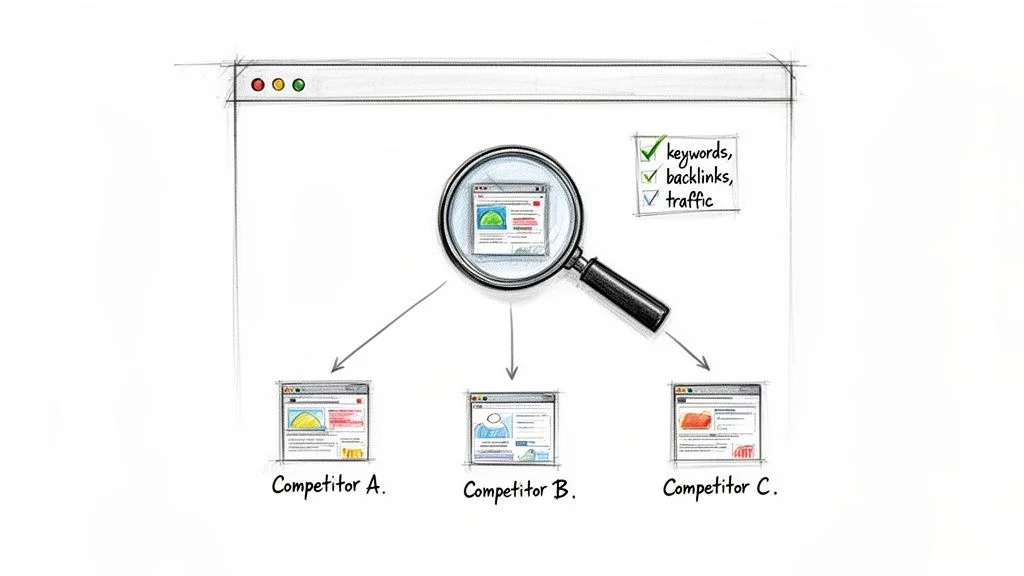
A solid competitor analysis is a treasure trove of strategic insights. By studying your rivals you can uncover:
- Effective marketing channels: where they're spending time and money tells you where your audience hangs out.
- Winning content strategies: the topics and formats they own, your cheat sheet for resonant content.
- Product or service gaps: features and pricing tiers competitors are ignoring — your opening.
- Customer pain points: complaints in reviews and social comments are a roadmap for product improvement.
Studies show that 68% of deals now involve a head-to-head comparison — you can't afford to be unprepared. Deep competitive knowledge sharpens sales pitches, strengthens marketing campaigns, and guides better product decisions.
Quick Wins: Find Competitors Using Google
Three free Google techniques — the related: operator, keyword searches, and SERP feature analysis — can build a solid competitor list in under an hour without spending anything on tools.
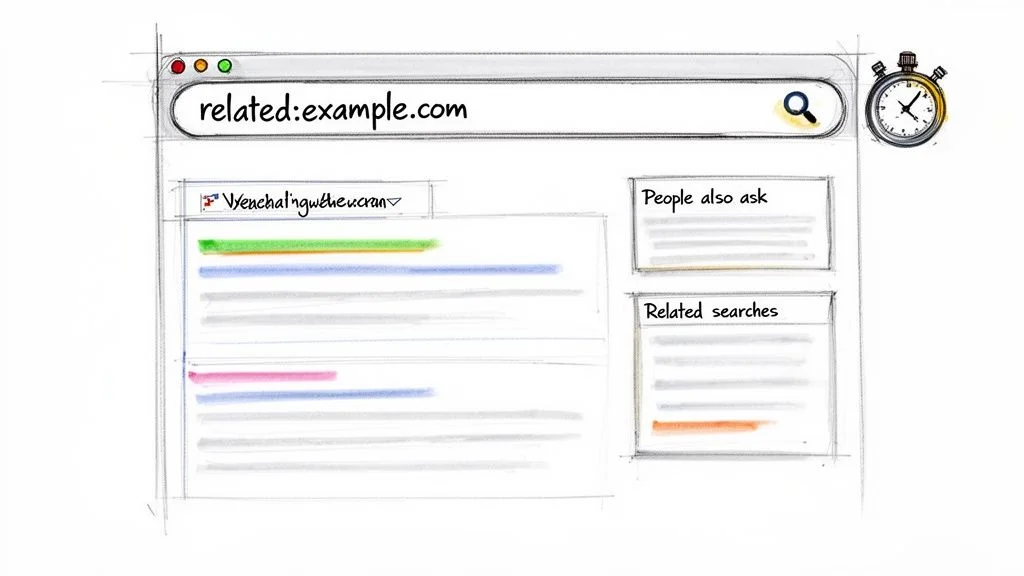
1. Find Instant Competitors with the related: Operator
Type related:domain.com into Google (no space after the colon). For example, related:asana.com returns a mix of direct and indirect competitors Google considers similar — a fantastic starting point.
2. Search Your 'Money' Keywords
Think like your customer. Search your top 3–5 most important keywords and study the first page. The sites consistently ranking in organic results and running ads are your direct search competitors. For more advanced data collection, see our guide on building a Google search results scraper.
3. Dig for Clues in SERP Features
The 'Related searches' section at the bottom of Google results points to niche competitors you might have missed. The 'People also ask' box reveals content-heavy competitors winning for your audience's pressing questions.
Level Up: Use SEO Tools to Analyse Your Rivals
Tools like Semrush and Ahrefs reveal keyword overlap, traffic sources, and backlink profiles — turning competitor research from guesswork into data-backed intelligence.
Find True Rivals via Keyword Overlap Analysis
A keyword overlap analysis shows which organic and paid terms you're both competing for. You can pinpoint direct SEO competitors, discover critical keyword gaps to add to your content plan, and identify who's bidding on the same PPC terms.
Follow the Traffic: Where Are Their Customers Coming From?
Plug a competitor's domain into Semrush or Ahrefs for a traffic source breakdown: organic search, paid search, referral, social, and direct. If a competitor gets 40% of traffic from organic, they've invested heavily in SEO — that tells you where to focus your own efforts.
Uncover Their Alliances with Backlink Analysis
Backlink tools show every site linking to your rivals — revealing PR and partnership opportunities, their most magnetic content, and guest-blogging targets for your outreach list. For a deeper look, see our guide on the top competitor tracking tools.
Think Like a Customer to Find Hidden Competitors
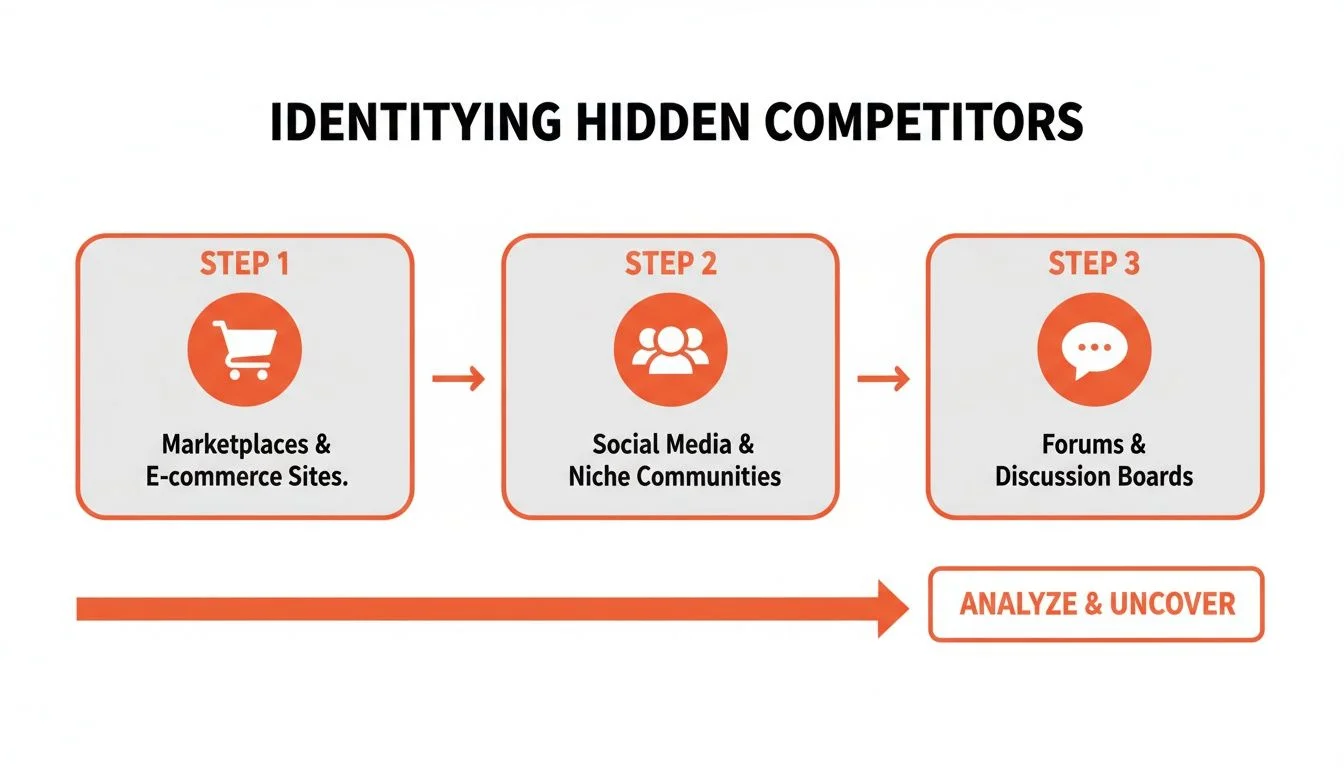
Hidden competitors — brands stealing your customers' attention without ranking on Google — are found by researching where customers actually make buying decisions: marketplaces, review platforms, social media, and niche forums.
Uncover Rivals on Marketplaces and Review Sites
Find your product or a known competitor on G2, Capterra, or TrustRadius, then click through to their 'Alternatives' page — a direct list of who your customers are comparing you to. On Amazon, the 'Amazon's Choice' badge holders are your top rivals for physical products.
Tap into Social Listening on LinkedIn and X
Track keywords and hashtags in your space. Look for threads where people ask for recommendations — the companies mentioned repeatedly are your real-world competitors, including emerging brands generating buzz before they rank on Google.
Explore Niche Communities and Forums
Reddit subreddits, industry-specific forums, and Facebook Groups are where your most informed customers talk shop. Becoming a fly on the wall uncovers competitor names and the exact language customers use to describe their pain points.
Put It on Autopilot: Automate Competitor Data Collection
AI-powered browser agents like Clura can automatically pull competitor features, pricing, reviews, job postings, and blog topics from any website — turning a full day of manual research into a few-minute workflow.
With a tool like Clura, you just point and click on the information you want to extract from a competitor's website. Once trained, the agent works through a list of competitor domains and outputs a perfectly organised CSV.
- Product features: build a complete side-by-side comparison instantly.
- Pricing tiers: capture all plans, prices, and inclusions.
- Customer reviews: scrape from G2 or their own site for unfiltered sentiment.
- Blog topics: track their content strategy and angles.
- Job postings: spot expansion plans and strategic shifts early.
Build a Living Competitive Intelligence Database
Clura's pre-built Similarweb metrics scraper and competitor templates let you pull traffic, pricing, and feature data on any schedule — automatically.
Add to Chrome — Free →Turning Data into Action: What to Do Next
Transform your competitor list into actionable strategy by sorting rivals into tiers, running a SWOT analysis on your top 3–5 primary competitors, and setting up continuous automated monitoring.
Sort Your Rivals into Tiers
- Primary competitors: direct head-to-head rivals selling the same thing to the same buyers — watch these like a hawk.
- Secondary competitors: solving the same problem differently (premium alternative, budget version) — learn tactics from them.
- Aspirational competitors: market leaders you're aiming to become — draw inspiration from their playbook.
Run a Quick SWOT Analysis
For each of your top 3–5 primary competitors, answer: What are they killing it at? Where are they fumbling? How can you exploit their weaknesses? What could they do to hurt you? A competitor's weakness — confusing pricing, clunky UI, poor support — is your invitation to win.
Frequently Asked Questions
What's the real difference between direct and indirect competitors?
Direct competitors sell a nearly identical product to the same customers (e.g., Asana vs. Trello). Indirect competitors solve the same problem with a completely different tool — for project management software, an Excel spreadsheet is a massive indirect competitor. You have to think about all the ways your customer could solve their problem, even low-tech ones.
How often should I do competitor research?
For your top 3–5 primary competitors, check in at least monthly — a lot can change in 30 days. For everyone else on your radar, quarterly is a solid baseline. A quick, consistent pulse-check is infinitely more powerful than a massive annual report that's obsolete the moment you finish it.
What are the best free tools to find competitors?
Start with Google's related: operator, review site 'Alternatives' pages on G2 and Capterra, and social listening on X and LinkedIn. Search for 'best tool for [your niche]' and read who real people recommend. These free methods build an incredibly solid list before you invest in paid tools.
How do I keep my competitive intelligence up to date?
Set up automated scraping agents to run on a weekly or monthly schedule — visiting competitor pages and pulling features, pricing, and job postings into a shared spreadsheet. This ensures your data stays current without requiring manual effort from your team.
Conclusion
Finding your competitors is the first step toward building a smarter, more resilient business strategy. By combining quick Google searches, deep dives with SEO tools, and customer-centric research on marketplaces and forums, you can build a complete picture of your competitive landscape.
The real power comes from automating this data collection. AI-powered scraping tools continuously monitor your rivals' every move, turning tedious research into actionable, real-time intelligence — so you can spot opportunities, counter threats, and stay one step ahead.
Explore related guides:
- Competitor Tracking Tools — compare the best platforms for ongoing competitive intelligence
- Google Search Results Scraper — automate keyword rank tracking and SERP data collection
- Retail Price Monitoring — monitor competitor pricing across Amazon, Shopify, and niche marketplaces
Stop Researching Competitors Manually
Clura automates competitor data collection — pricing, features, job postings, and reviews — on any schedule. Explore prebuilt templates and get your first workflow running today.
Add to Chrome — Free →