
Best Competitor Analysis & Tracking Tools
Competitor tracking tools help you monitor changes across rival websites, pricing pages, SEO rankings, ads, reviews, job posts, and product catalogs. Competitor analysis tools help you turn those signals into decisions.
This guide breaks down the 12 best competitor analysis and tracking tools available today — with pros, cons, pricing context, and practical workflows for sales, marketing, e-commerce, recruiting, and product teams. For a narrower monitoring-focused shortlist, see the best competitor tracking tools guide.
Track Competitor Data in One Click
Clura's AI browser agent extracts competitor pricing, product data, reviews, job posts, and page content from public websites into clean CSV files.
Add to Chrome — Free →Competitor Tracking Tools vs Competitor Analysis Tools
Competitor tracking tools collect ongoing signals such as price changes, website updates, job posts, and reviews. Competitor analysis tools interpret those signals for strategy, positioning, SEO, sales, and product decisions.
| Need | Best Tool Type | Example Output |
|---|---|---|
| Track price or product changes | Competitor tracking tool or scraper | Price, stock, promo, product URL, timestamp |
| Compare SEO and paid search | SEO competitor analysis platform | Keyword gaps, ads, backlinks, traffic estimates |
| Monitor website changes | Website monitoring or CI platform | Changed copy, new pages, messaging shifts |
| Collect custom competitor datasets | No-code browser scraper | Reviews, listings, job posts, product catalogs, CSV |
If your team needs recurring alerts and dashboards, start with a dedicated monitoring platform. If you need flexible row-level data from pages that standard dashboards do not cover, use Clura as the extraction layer and send the CSV into your spreadsheet, CRM, or BI workflow.
1. Clura — Best for Custom Competitor Tracking Data
Clura is a no-code AI browser agent that collects custom competitor tracking data from public websites and exports clean structured rows to CSV.
Clura is useful when competitor tracking requires data that standard dashboards do not expose: product rows, marketplace listings, review tables, public job posts, local business listings, directory profiles, pricing pages, or feature pages. As a Chrome extension, it lets non-technical users collect that data without writing selectors or scripts.
Key Features & Use Cases
- Custom competitor tracking: Capture competitor prices, product names, availability, reviews, job posts, locations, and source URLs from public pages.
- Pre-built templates: Start from ecommerce, directory, maps, job-board, and marketplace workflows instead of building a scraper from scratch.
- Broad site compatibility: Works across ecommerce sites, job boards, directories, review sites, local listings, and niche marketplaces.
- Clean Data Exports: All extracted data is instantly organized into a structured CSV file, eliminating manual data cleaning.
Pricing
- Free Plan: 500 rows per scrape, 20 scrapes per day.
- Lifetime Plan: $29.99 one-time with unlimited rows per scrape.
| Pros | Cons |
|---|---|
| Effortless no-code scraping — Chrome extension makes it easy for non-technical users | Browser dependent — limited to Chromium-based browsers |
| Powerful automation — AI agents and templates save significant time | Variable plan limits — confirm current details on official website |
| High-quality structured data — exports are clean and immediately usable | |
| Excellent user ratings — 4.9/5 from 1,000+ users |
Build a Competitor Tracking Workflow Today
Clura's templates help you scrape competitor pricing, reviews, product data, job posts, and public page changes from websites — no code required.
Add to Chrome — Free →2. Semrush — Best All-in-One Digital Intelligence Suite
Semrush is an all-in-one competitive intelligence command center covering SEO, PPC, traffic analytics, and content marketing with a powerful Domain vs. Domain comparison feature.
Semrush is less a single tool and more an all-in-one competitive intelligence command center. The Domain vs. Domain feature allows you to visually compare your website against up to four competitors, highlighting keyword gaps and backlink opportunities. Its Traffic Analytics module reveals competitor market share, audience overlap, and top traffic sources.
Key Features
- SEO & Content: Uncover exact organic and paid keywords your rivals are targeting.
- Market Intelligence: Use Traffic Analytics and Market Explorer to benchmark performance and discover emerging players.
- Advertising Research: See competitors' live ad copy, analyze ad spend trends, and identify effective paid keywords.
Pricing starts with the Pro plan at around $129.95/month. Website: semrush.com
3. Ahrefs — Best for SEO & Backlink Analysis
Ahrefs provides the industry's largest backlink index combined with a Content Gap tool that instantly shows which competitor keywords you are missing.
When it comes to backlink analysis and SEO-driven competitor research, Ahrefs is an undisputed champion. The Content Gap feature instantly shows you keywords your competitors rank for but you don't, creating a clear roadmap for your content strategy. Site Explorer provides a historical view of competitor performance.
Key Features
- Backlink & SEO Analysis: Get a complete picture of any competitor's backlink profile, top organic keywords, and paid search campaigns.
- Content Gap Discovery: Pinpoint valuable keywords competitors rank for that you are missing.
- Rank Tracking: Monitor search visibility against key competitors over time.
Pricing starts with the Lite plan at around $99/month. Website: ahrefs.com
4–12. Similarweb, SpyFu, Moz Pro, BuzzSumo, Crayon, Brandwatch, G2, BuiltWith & Owler
Beyond the top 3, this lineup covers every competitive intelligence need — from traffic benchmarking and content strategy to sales enablement, social listening, and tech stack analysis.
Similarweb
Provides estimated traffic numbers, engagement metrics, and acquisition channel breakdowns for any website. Ideal for market sizing and understanding audience behavior. Custom pricing — contact sales. Website: similarweb.com
SpyFu
Specializes in reverse-engineering competitors' PPC and SEO strategies with 15+ years of historical ad data. The 'Kombat' feature highlights keyword gaps vs. up to two competitors. Basic plan starts at ~$39/month. Website: spyfu.com
Moz Pro
An approachable SEO platform with Link Explorer, Keyword Explorer, and rank tracking. Great for small teams and startups. Standard plan starts at ~$99/month. Website: moz.com/products/pro
BuzzSumo
A content intelligence platform showing the most-shared competitor content across social networks, along with backlinks earned and influencers amplifying their message. Content Creation plan starts at $199/month. Website: buzzsumo.com
Crayon
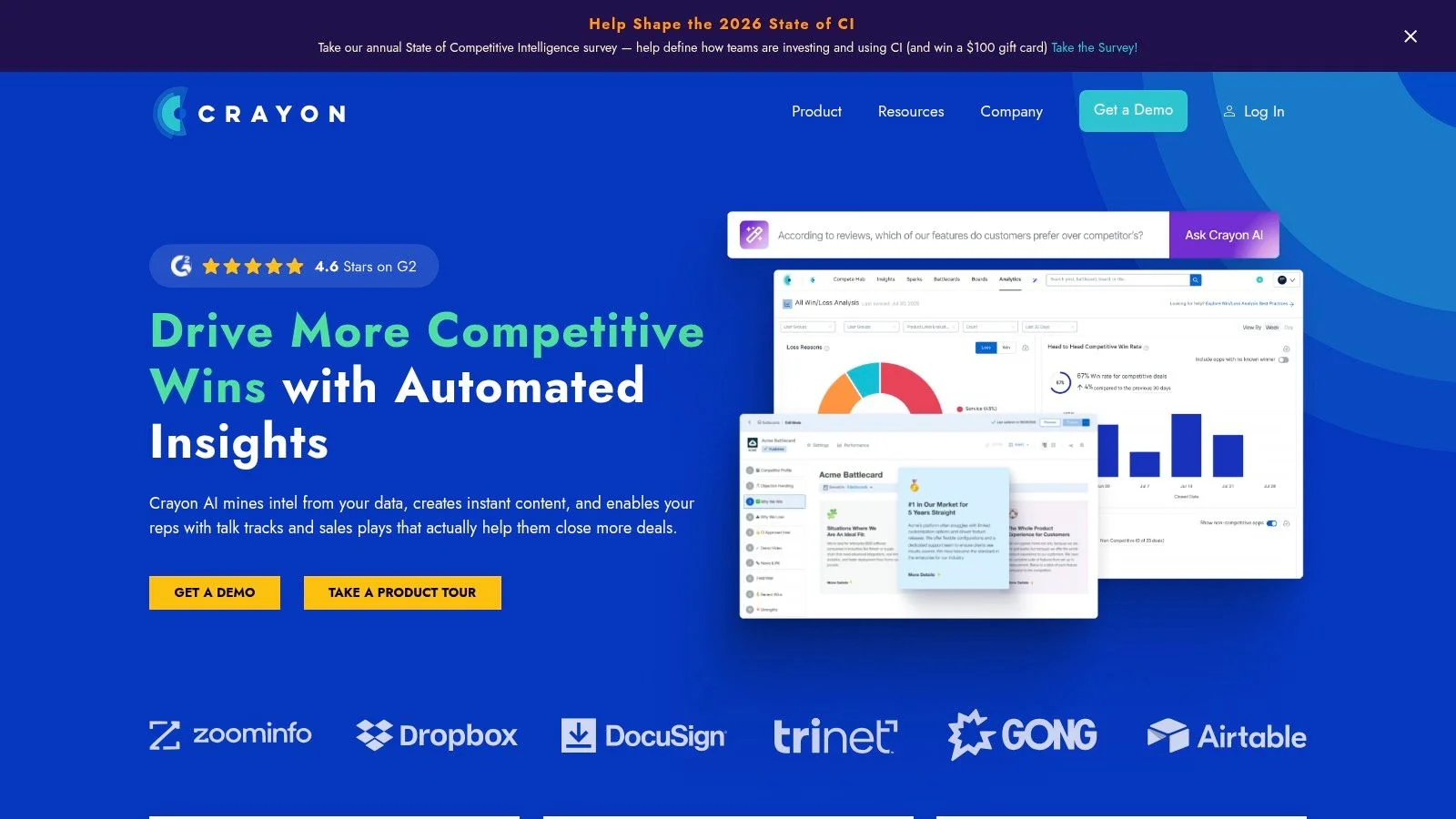
A purpose-built CI platform that operationalizes competitor intelligence into dynamic battlecards and sales enablement tools. Tracks 100+ signal types across competitors' digital footprints. Custom pricing. Website: crayon.co
Brandwatch
Enterprise-grade social listening and consumer intelligence with AI-powered image and logo recognition. Identifies competitor product appearances in social posts even without brand mentions. Custom pricing. Website: brandwatch.com
G2 — Competitive Intelligence Category
A crowd-sourced marketplace for discovering and evaluating hundreds of CI tools, with peer reviews, G2 Grid rankings, and side-by-side comparisons. Completely free to browse. Website: g2.com
BuiltWith
Reveals the exact technologies competitors use to run their websites — a goldmine for B2B SaaS sales targeting. Basic plan at $295/month. Website: builtwith.com
Owler
Lightweight crowdsourced company intelligence with real-time alerts on funding, leadership changes, and press mentions. Free Community plan available; Pro at $35/month. Website: owler.com
Top 12 Competitor Analysis and Tracking Tools Compared
A side-by-side comparison of competitor analysis and tracking tools should compare core features, target users, unique value, and pricing.
| Tool | Core Features | Best For | Entry Price |
|---|---|---|---|
| Clura | No-code AI scraping, prebuilt templates, CSV export, broad site coverage | Non-technical teams needing custom competitor data | Free (20 scrapes/day, 500 rows/scrape); Lifetime at $29.99 one-time |
| Semrush | SEO, PPC, traffic analytics, market intelligence | Marketing teams and agencies | From ~$129.95/mo |
| Ahrefs | Backlinks, keywords, content gap, rank tracking | SEO teams and technical marketers | From ~$99/mo |
| Similarweb | Traffic estimates, channel splits, market benchmarking | Market researchers and strategy teams | Custom pricing |
| SpyFu | PPC/ad history, keyword gaps, rank tracking | Cost-sensitive PPC/SEO teams | From ~$39/mo |
| Moz Pro | Rank tracking, Link Explorer, site audits | Small teams and SEO generalists | From ~$99/mo |
| BuzzSumo | Content analyzer, influencer/media database | Content and PR teams | From $199/mo |
| Crayon | Battlecards, automated tracking, sales enablement | Revenue and product marketing teams | Custom pricing |
| Brandwatch | Social listening, sentiment, image recognition | Enterprise brand teams | Custom pricing |
| G2 | Vendor comparisons, user reviews, feature filters | Buyers shortlisting CI vendors | Free |
| BuiltWith | Technology profiles, lead lists, market trends | B2B sales targeting by tech stack | From $295/mo |
| Owler | Company news alerts, funding updates, watchlists | SMBs and lightweight CI users | Free + $35/mo Pro |
How to Choose the Right Competitor Analysis Tools
The best competitive intelligence stack combines tracking tools for ongoing signals, SEO platforms for keyword gaps, traffic tools for market sizing, and custom scraping tools for row-level data.
- For SEO & Content Dominance: Start with Ahrefs or Semrush. Pair with BuzzSumo to uncover viral content trends.
- For Market & Sales Intelligence: Use Similarweb for traffic insights. BuiltWith and Owler provide targeted data for sales outreach.
- For Brand & Product Strategy: Crayon for competitor marketing campaigns and product launches. Brandwatch for deep consumer intelligence.
While these specialized platforms are useful, they often provide aggregated data. A tool like Clura fills the gaps — pulling pricing data, collecting new job postings from rivals, or extracting specific product details that dashboards miss. Start with one or two tools that solve your most pressing problem, then expand your stack as needs evolve.
Frequently Asked Questions
What are competitor tracking tools?
Competitor tracking tools monitor changes across competitor websites, pricing pages, product catalogs, reviews, SEO rankings, ads, social channels, and job posts. Some tools provide dashboards and alerts, while browser scrapers like Clura collect custom row-level data into CSV files for analysis.
What is the best free competitor analysis tool?
G2 is the best free meta-resource for researching CI tools. Owler has a free Community plan for company news alerts. Clura offers a free plan with 20 scrapes/day, 500 rows/ scrape for custom competitor data extraction. For SEO, Ahrefs and Moz both offer limited free features. Google's own Search Console and Google Alerts are also free and surprisingly powerful for basic monitoring.
What is the difference between Semrush and Ahrefs for competitor analysis?
Semrush is broader — covering SEO, PPC, social media, and traffic analytics in one platform, making it ideal for marketing teams. Ahrefs is deeper on SEO specifics, particularly backlink analysis and content gap research, making it the preferred choice for SEO professionals. Most serious teams use both, as they have complementary strengths.
How can I monitor competitor prices automatically?
Use a no-code scraping tool like Clura to set up an AI agent that visits competitor product pages on a daily or weekly schedule and extracts pricing, stock status, and promotional data into a CSV. For deeper price intelligence across marketplaces, tools like Prisync specialize in e-commerce price tracking. See our full guide on how to monitor competitor prices for a step-by-step workflow.
Is it legal to use competitor analysis tools?
Yes. Collecting publicly available data from competitor websites using automated tools is legal in most jurisdictions, supported by key US court rulings including hiQ v. LinkedIn. Best practices: respect the site's robots.txt file, do not scrape data behind a login you do not own, pace your requests to avoid server overload, and only collect data for legitimate business analysis purposes.
Conclusion
Effective competitor analysis is about building a strategic tech stack. No single platform can do it all — the real insight comes from combining the strengths of different tools to create a 360-degree view of your competitive landscape.
Start with the tools that solve your most pressing problem: Ahrefs or Semrush for SEO, Similarweb for traffic benchmarking, Crayon for sales enablement. Then use a flexible data extraction tool like Clura to fill the granular gaps those dashboards inevitably leave behind.
The competitive landscape is always changing, but with the right intelligence toolkit, you will always be one step ahead.
Explore related guides:
- Best Competitor Tracking Tools — monitor competitor websites, pricing, SEO, ads, and product changes
- How to Monitor Competitor Prices —
- How to Extract Data from Websites —
Fill the Data Gaps in Your Competitive Strategy — Free
Clura extracts custom, real-time competitor data from any website without code. Combine high-level insights with granular details only targeted scraping can provide.
Add to Chrome — Free →